SMALLTALK LAB
Base conversion: build a number one digit at a time
Write an integer encoder using quotient and remainder, reverse the process with a positional fold, and test binary through hexadecimal in Squeak.
Before you begin
Know integer arithmetic, blocks and collections. We convert nonnegative integers to digit strings in bases 2 through 16. This is a value-to-text operation, not a change to the number itself.
These are native Squeak 6.1 examples. Each checkpoint is independent: open the download as text, copy one complete expression into Workspace and choose Print it. Do not file in the checkpoint collection as a class definition.
01 - Separate quotient and remainder
Integer quotient tells us how many full groups of the base fit. Remainder is the ungrouped part, and becomes the rightmost digit. The identity n = quotient * base + remainder explains the algorithm.
| n base |
n := 45. base := 2.
{n // base. n \\ base}
Expected: {22. 1.}
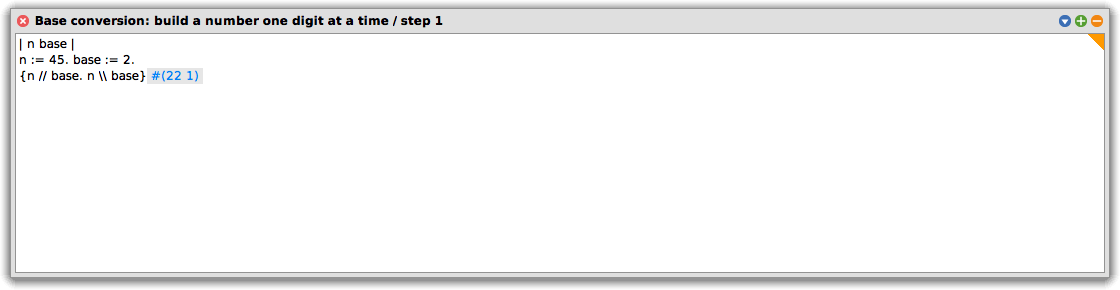
Try it: Check 45 = 22*2+1. Try base 10 to obtain quotient 4 and remainder 5.
02 - Collect low digits first
Repeated division removes the least significant digit at every iteration. These remainders are therefore produced in reverse reading order. Stop when the quotient is zero.
| n digits |
n := 45. digits := OrderedCollection new.
[n > 0] whileTrue: [
 digits add: n \\ 2.
 n := n // 2].
digits asArray
Expected: {1. 0. 1. 1. 0. 1.}
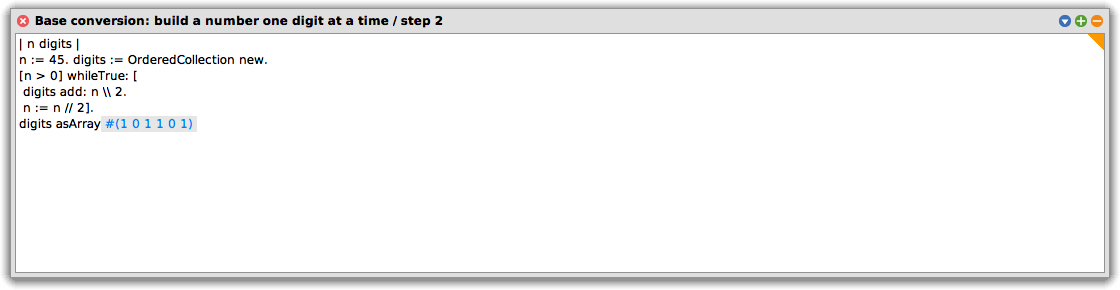
Try it: Read these from right to left: 101101 is binary 45.
03 - Map a digit to a character
An alphabet allows bases above ten to use letters. Arrays and Strings are one-based in Squeak, so a numeric digit zero maps to position one.
| alphabet |
alphabet := '0123456789ABCDEF'.
{alphabet at: 1. alphabet at: 11. alphabet at: 16}
Expected: {$0. $A. $F.}
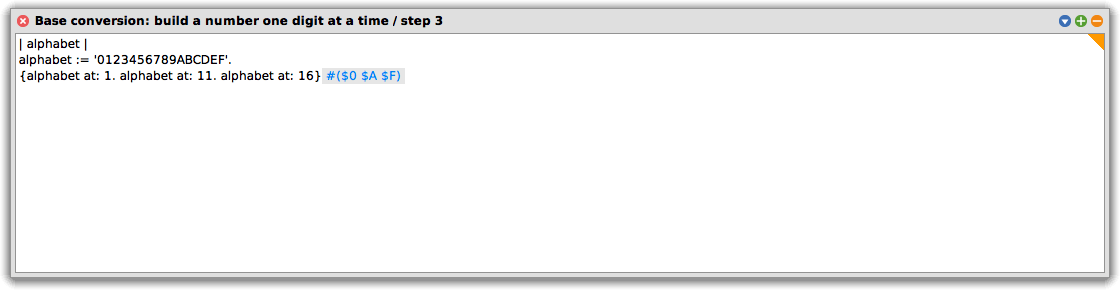
Try it: The digit value 15 becomes F, not a two-character decimal string.
04 - Build the reusable encoder
addFirst: inserts each new high digit at the front. Validate before dividing, and explicitly handle zero because its loop never runs. This teaching version favors clear assembly over optimal large-string performance.
| encode |
encode := [:number :base | | n out alphabet |
 (number isInteger and: [number >= 0])
  ifFalse: [Error signal: 'Use a nonnegative integer'].
 (base isInteger and: [base between: 2 and: 16])
  ifFalse: [Error signal: 'Base must be from 2 to 16'].
 alphabet := '0123456789ABCDEF'.
 n := number. out := OrderedCollection new.
 [n > 0] whileTrue: [
  out addFirst: (alphabet at: (n \\ base)+1).
  n := n // base].
 out isEmpty ifTrue: [out add: $0].
 String withAll: out].
encode value: 45 value: 2
Expected: '101101'
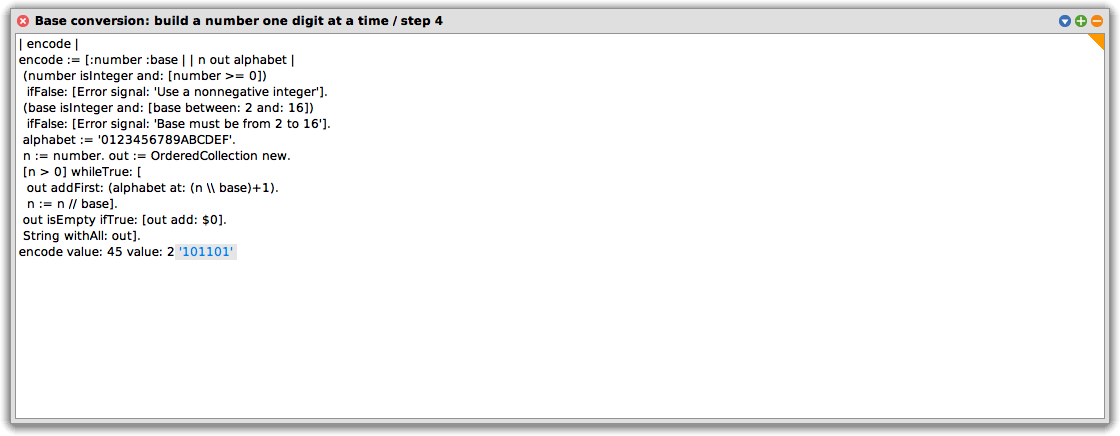
Try it: Change the base to 16; the same integer is written 2D.
05 - Handle zero and other bases
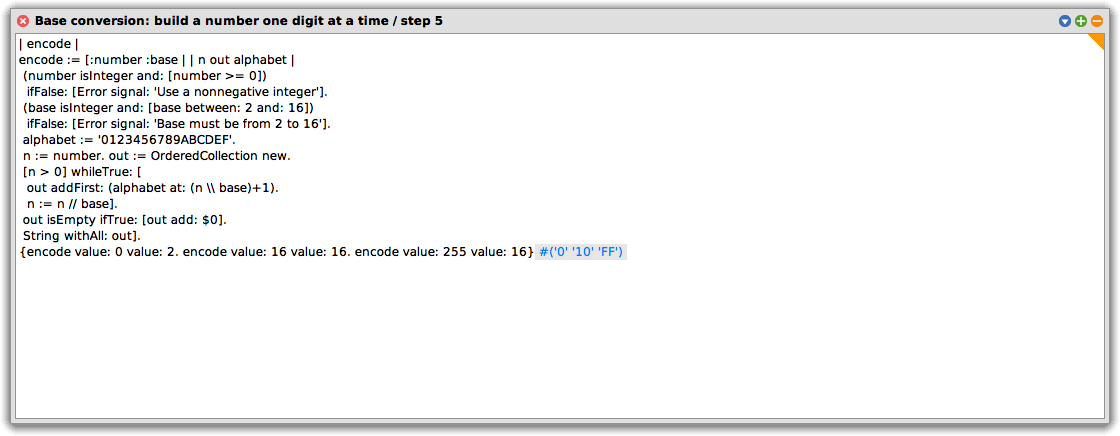
Zero has one digit. Sixteen needs two digits in base sixteen. The output uses uppercase A through F, which is our chosen notation rather than a change in numeric value.
| encode |
encode := [:number :base | | n out alphabet |
 (number isInteger and: [number >= 0])
  ifFalse: [Error signal: 'Use a nonnegative integer'].
 (base isInteger and: [base between: 2 and: 16])
  ifFalse: [Error signal: 'Base must be from 2 to 16'].
 alphabet := '0123456789ABCDEF'.
 n := number. out := OrderedCollection new.
 [n > 0] whileTrue: [
  out addFirst: (alphabet at: (n \\ base)+1).
  n := n // base].
 out isEmpty ifTrue: [out add: $0].
 String withAll: out].
{encode value: 0 value: 2. encode value: 16 value: 16. encode value: 255 value: 16}
Expected: {'0'. '10'. 'FF'.}
Try it: Try 255 in base 10 and base 2.
06 - Read a digit string back
A left fold multiplies the accumulated prefix by the base, then adds the next digit. This example deliberately supplies a known valid binary string; a public decoder must reject invalid digits.
| result |
result := 0.
'101101' do: [:c | result := result*2+(c asciiValue-$0 asciiValue)].
result
Expected: 45
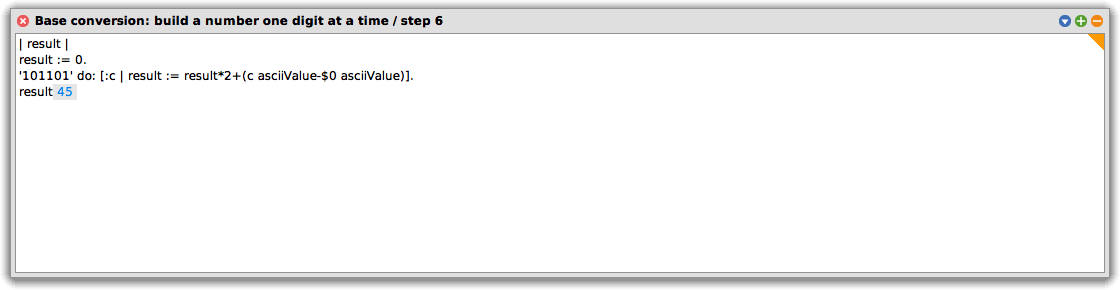
Try it: After reading 101, the accumulator is five. The next 1 makes eleven.
07 - Round-trip a family of values
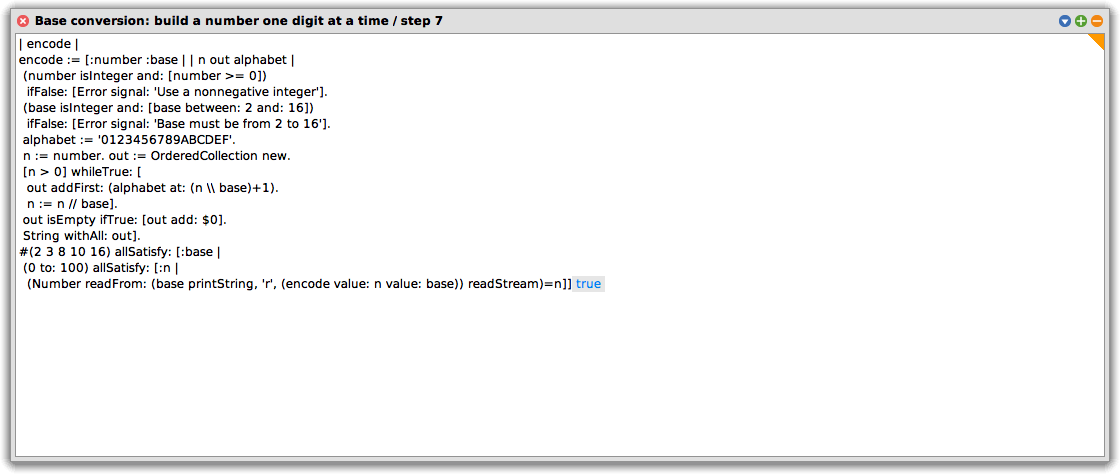
Squeak's Number reader accepts radix notation such as 2r101101. Use it as an independent oracle for our encoder across several bases and values. This test covers zero and boundaries between digit lengths.
| encode |
encode := [:number :base | | n out alphabet |
 (number isInteger and: [number >= 0])
  ifFalse: [Error signal: 'Use a nonnegative integer'].
 (base isInteger and: [base between: 2 and: 16])
  ifFalse: [Error signal: 'Base must be from 2 to 16'].
 alphabet := '0123456789ABCDEF'.
 n := number. out := OrderedCollection new.
 [n > 0] whileTrue: [
  out addFirst: (alphabet at: (n \\ base)+1).
  n := n // base].
 out isEmpty ifTrue: [out add: $0].
 String withAll: out].
#(2 3 8 10 16) allSatisfy: [:base |
 (0 to: 100) allSatisfy: [:n |
  (Number readFrom: (base printString, 'r', (encode value: n value: base)) readStream)=n]]
Expected: true
Try it: Add 1024 and 65535 to spot-check larger boundaries.
08 - Reject a meaningless base
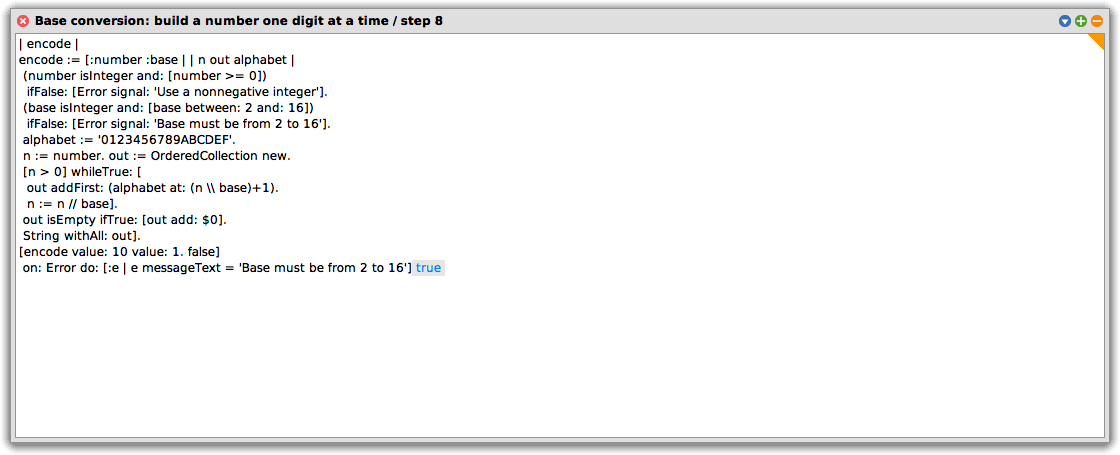
Base one would not reduce the quotient, so an unguarded loop could run forever. Reject it before starting. The test checks our precise message instead of treating any exception as success.
| encode |
encode := [:number :base | | n out alphabet |
 (number isInteger and: [number >= 0])
  ifFalse: [Error signal: 'Use a nonnegative integer'].
 (base isInteger and: [base between: 2 and: 16])
  ifFalse: [Error signal: 'Base must be from 2 to 16'].
 alphabet := '0123456789ABCDEF'.
 n := number. out := OrderedCollection new.
 [n > 0] whileTrue: [
  out addFirst: (alphabet at: (n \\ base)+1).
  n := n // base].
 out isEmpty ifTrue: [out add: $0].
 String withAll: out].
[encode value: 10 value: 1. false]
 on: Error do: [:e | e messageText = 'Base must be from 2 to 16']
Expected: true
Try it: Also reject negative numbers and fractional bases.
Watch the computed states
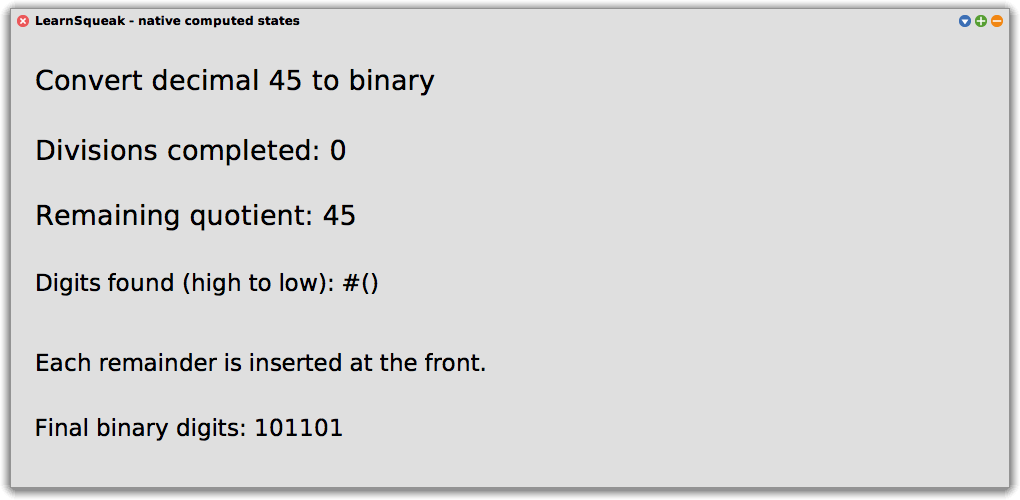
Download the visual experiment. Select the entire expression and Do it. Change stage := 0. to another supported stage, close the previous window, and run again. The GIF replays those native states. This example needs native Squeak; no new browser playground compatibility is claimed.
Reason about correctness and limits
There are O(log_base(n)) digits for a positive integer. Repeated integer division determines them; the cost of large-integer arithmetic grows with the input size. addFirst: on OrderedCollection can move elements, so this clear version is not a claim of optimal string-building complexity.
Our contract excludes signs, fractions and bases outside 2–16. A negative value can be handled by recording a sign and encoding its magnitude, but do not silently apply this rule to arbitrary text.
Smalltalk radix literals are already available, for example 16rFF. The purpose here is to understand positional representation rather than replace the built-in reader.
Three practice challenges
Challenge 1
Why is the remainder always a valid digit?
Show solution
For a positive base and nonnegative n, remainder lies from zero through base minus one.
Challenge 2
How would you avoid repeated front insertion?
Show solution
Append low digits, then reverse the collection once before constructing the String.
Challenge 3
Why is binary 100000 equal to 32?
Show solution
Only the position with weight 2 raised to 5 is set; all lower position weights contribute zero.
Continue learning
Integer Bitsets | Euclidean Gcd | First Text
Environment reference: official Squeak documentation. This lesson and its examples are original. Verified using native Squeak 6.1 build 23976 on Linux.