SMALLTALK LAB
Extended Euclid in Squeak: Find Modular Inverses
Carry two coefficients through Euclid’s remainders, prove a Bezout identity, and use it to solve modular equations with exact integers.
Before you begin
Open Workspace and Print it on one complete checkpoint at a time. These independent examples use nonnegative integer inputs; at least one must be positive. You need no packages. The visual download shows the evolving coefficient rows for 99 and 78.
These are native Squeak 6.1 examples. Each checkpoint is independent: open the download as text, copy one complete expression into Workspace and choose Print it. Do not file in the checkpoint collection as a class definition.
Expected values are Smalltalk expressions. The printer may show explicit Symbol markers: #(A B) and #(#A #B) represent the same array of Symbols.
01 - Read a remainder as an equation
Integer division gives a quotient and remainder: a = q*b + r. We will preserve not only each remainder but also how it was made from the original inputs. Parentheses are important because Smalltalk binary messages have equal precedence and associate left to right.
| a b q remainder |
a := 99. b := 78.
q := a // b.
remainder := a - (q * b).
{q. remainder. a = ((q * b) + remainder)}
Expected: #(1 21 true)
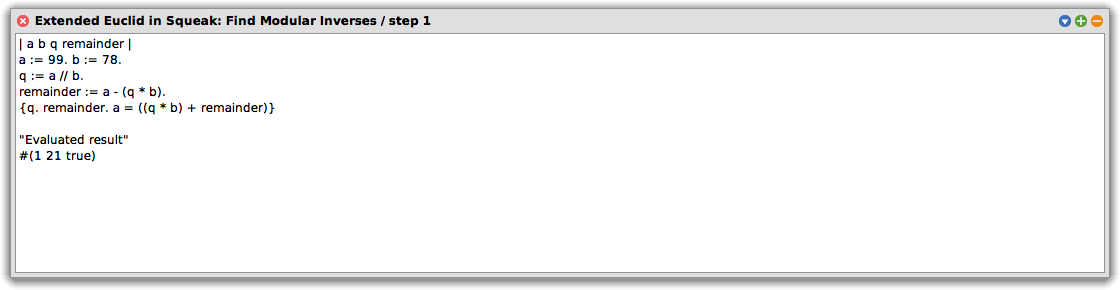
Try it: Try 78 and 21: the quotient is 3 and remainder is 15.
02 - Start with two coefficient rows
A row #(r s t) means r = s*a + t*b. The initial rows are trivial: a = 1*a + 0*b, and b = 0*a + 1*b. Keeping this identity true is the whole algorithm.
| a b rows |
a := 99. b := 78.
rows := #((99 1 0) (78 0 1)).
rows collect: [:row | row first = (((row at: 2) * a) + ((row at: 3) * b))]
Expected: #(true true)
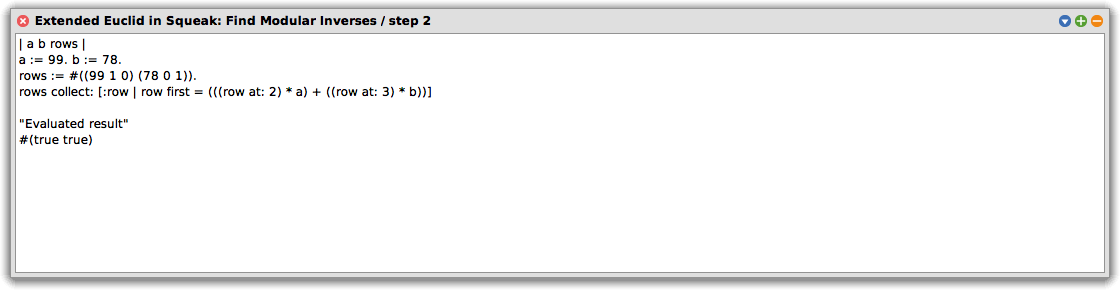
Try it: The coefficient columns refer to the original a and b, not to the changing remainders.
03 - Subtract the same multiple in all three columns
The next row is oldRow minus q times currentRow. Subtracting identities yields a new identity. For 99 and 78 the first new row is #(21 1 -1), because 21 = 99 - 78.
| previous current q next |
previous := #(99 1 0). current := #(78 0 1).
q := previous first // current first.
next := (1 to: 3) collect: [:i |
 (previous at: i) - (q * (current at: i))].
next asArray
Expected: #(21 1 -1)
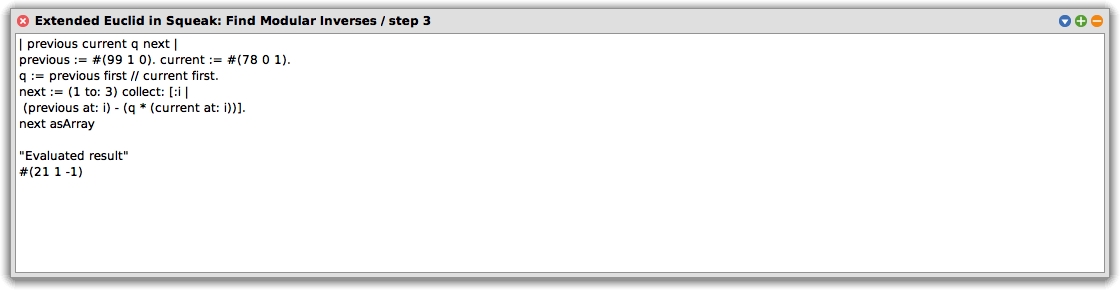
Try it: Apply the same operation to #(78 0 1) and #(21 1 -1); expect #(15 -3 4).
04 - Loop until the current remainder is zero
Keep old and current values for the remainder and both coefficients. A temporary next value prevents overwriting a value before it is used. When r reaches zero, oldR is the gcd and oldS, oldT are its Bezout coefficients. The final zero row is not the answer.
| a b oldR r oldS s oldT t |
a := 99. b := 78.
oldR := a. r := b.
oldS := 1. s := 0. oldT := 0. t := 1.
[r ~= 0] whileTrue: [ | q next |
 q := oldR // r.
 next := oldR - (q * r). oldR := r. r := next.
 next := oldS - (q * s). oldS := s. s := next.
 next := oldT - (q * t). oldT := t. t := next].
{oldR. oldS. oldT}
Expected: #(3 -11 14)
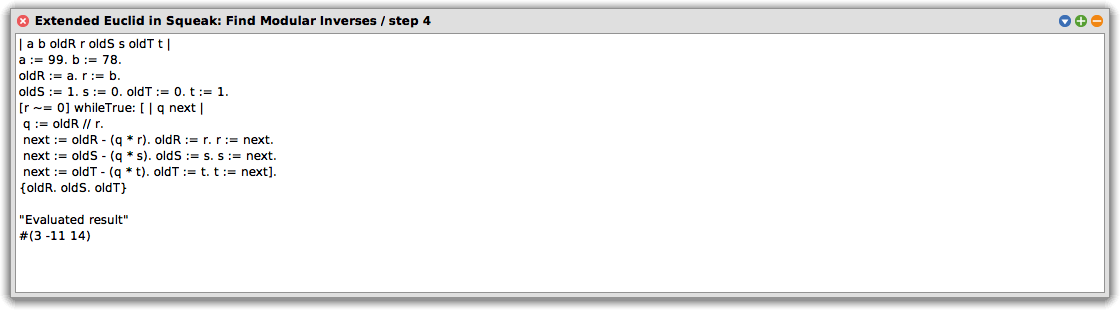
Try it: Check -11*99 + 14*78 by hand: both terms may be much larger than their sum.
05 - Verify the identity independently
Instead of trusting the printed coefficients, substitute them into the original equation. Also verify divisibility of both inputs. Exact integer arithmetic avoids rounding error, and Squeak grows integers beyond machine-word size as needed.
| a b oldR r oldS s oldT t |
a := 99. b := 78.
oldR := a. r := b.
oldS := 1. s := 0. oldT := 0. t := 1.
[r ~= 0] whileTrue: [ | q next |
 q := oldR // r.
 next := oldR - (q * r). oldR := r. r := next.
 next := oldS - (q * s). oldS := s. s := next.
 next := oldT - (q * t). oldT := t. t := next].
{((oldS * a) + (oldT * b)) = oldR.
 (a \\ oldR) = 0. (b \\ oldR) = 0}
Expected: #(true true true)
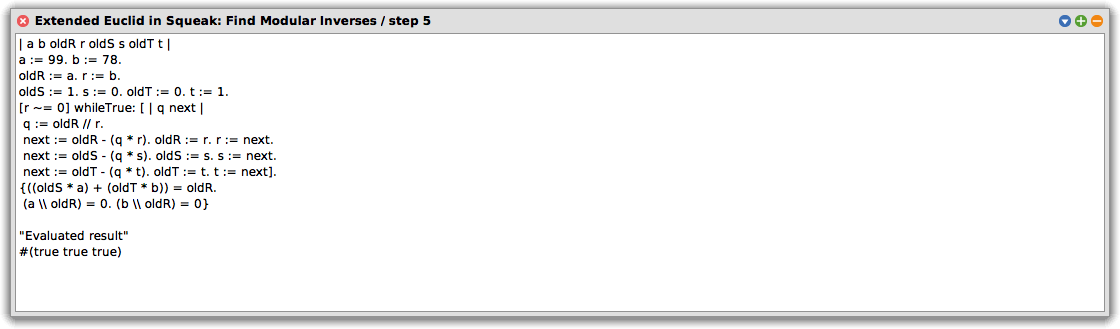
Try it: Change the inputs to 240 and 46. The gcd is 2 and this update order returns coefficients -9 and 47.
06 - Turn a coefficient into a modular inverse
For a modulus m greater than one, a has an inverse only when gcd(a,m) is 1. Then s*a + t*m = 1 implies s*a is congruent to 1 modulo m. Squeak remainder with a positive modulus normalizes a negative coefficient into the range 0 through m-1.
| a b oldR r oldS s oldT t |
a := 17. b := 43.
oldR := a. r := b.
oldS := 1. s := 0. oldT := 0. t := 1.
[r ~= 0] whileTrue: [ | q next |
 q := oldR // r.
 next := oldR - (q * r). oldR := r. r := next.
 next := oldS - (q * s). oldS := s. s := next.
 next := oldT - (q * t). oldT := t. t := next].
{oldR. oldS. oldS \\ b. ((oldS \\ b) * a) \\ b}
Expected: #(1 -5 38 1)
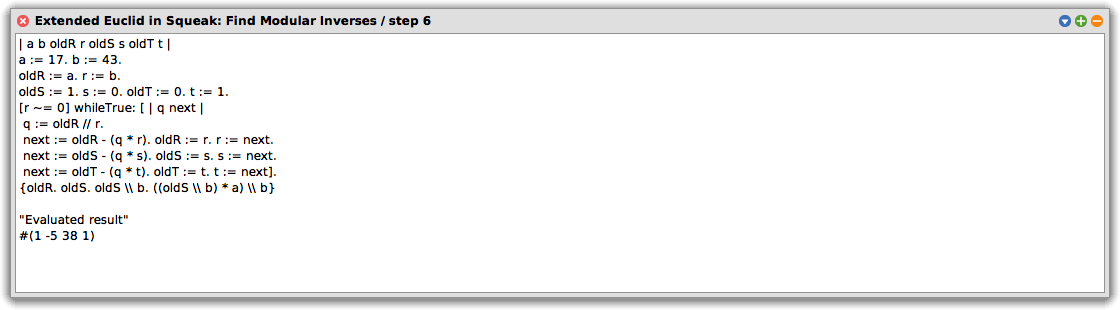
Try it: 38 is an inverse of 17 modulo 43. The coefficient -5 represents the same residue.
07 - Detect when no inverse exists
Do not normalize and advertise a coefficient unless the gcd is one. For 12 modulo 18 every product remains divisible by 6 modulo 18, so it cannot equal 1. A symbol is an explicit failure result in this small demonstration.
| a b oldR r oldS s oldT t |
a := 12. b := 18.
oldR := a. r := b.
oldS := 1. s := 0. oldT := 0. t := 1.
[r ~= 0] whileTrue: [ | q next |
 q := oldR // r.
 next := oldR - (q * r). oldR := r. r := next.
 next := oldS - (q * s). oldS := s. s := next.
 next := oldT - (q * t). oldT := t. t := next].
oldR = 1 ifTrue: [oldS \\ b] ifFalse: [#noInverse]
Expected: #noInverse
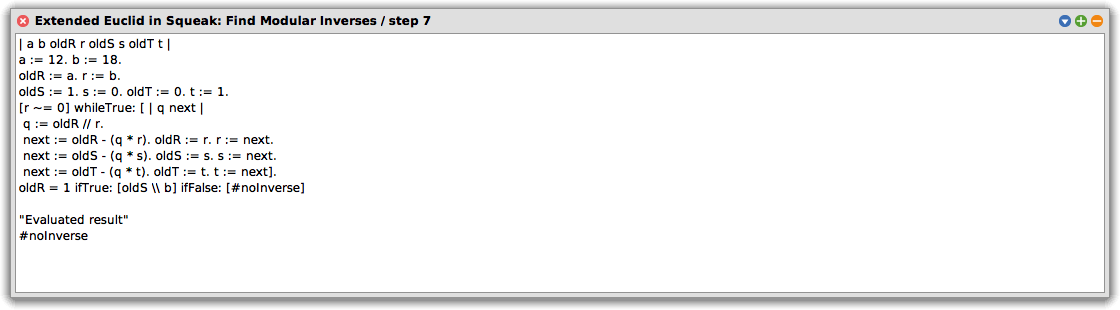
Try it: The identity still exists: the coefficients explain gcd 6, not an inverse of 12.
08 - Solve a modular linear equation
To solve 17*x = 5 modulo 43, multiply 5 by the inverse of 17 and normalize. The resulting x=18 is the unique residue in 0..42 because the gcd is one. This example checks its answer by substitution.
| a b oldR r oldS s oldT t |
a := 17. b := 43.
oldR := a. r := b.
oldS := 1. s := 0. oldT := 0. t := 1.
[r ~= 0] whileTrue: [ | q next |
 q := oldR // r.
 next := oldR - (q * r). oldR := r. r := next.
 next := oldS - (q * s). oldS := s. s := next.
 next := oldT - (q * t). oldT := t. t := next].
{(5 * (oldS \\ b)) \\ b.
 (a * ((5 * (oldS \\ b)) \\ b)) \\ b}
Expected: #(18 5)
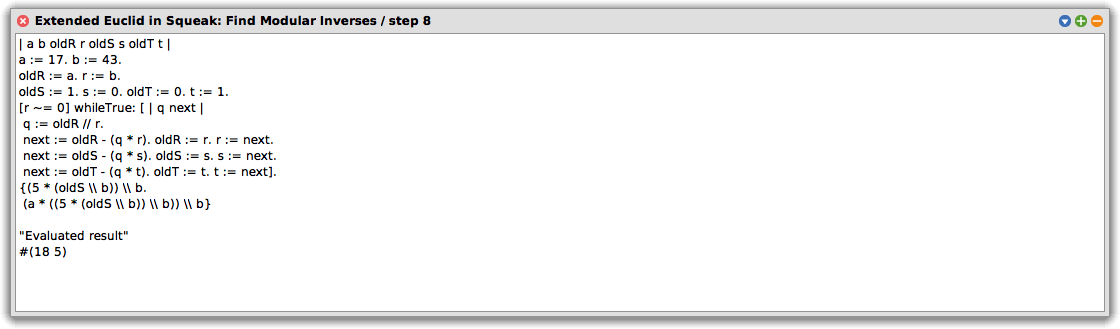
Try it: Replace 5 with 9: the solution is 41. Always substitute the result into the original congruence.
Watch the computed states
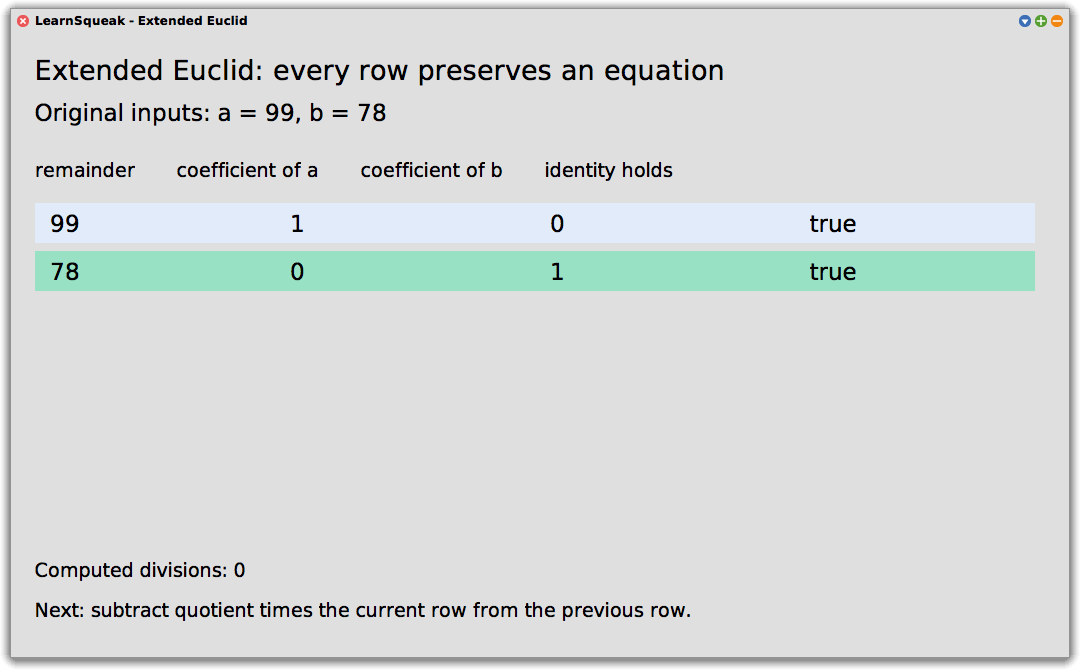
Download the visual experiment. Select the entire expression and Do it. Change stage := 0. to another supported stage, close the previous window, and run again. The GIF replays those native states. This example needs native Squeak; no new browser playground compatibility is claimed.
Reason about correctness and limits
These checkpoints require nonnegative integers and at least one positive input. The modular examples additionally require b > 1. Reject other inputs or deliberately normalize signs in a reusable API.
Squeak uses // for integer quotient and \\ for remainder. / would introduce Fractions, breaking the intended remainder recurrence.
Update old/current pairs using temporary values. Reassigning oldR before calculating the new remainder changes the algorithm.
Bezout coefficients need not be positive or unique. Normalize only the inverse residue, not the identity coefficients.
The algorithm performs O(log min(a,b)) Euclidean divisions for positive inputs; this is a count of arithmetic operations, not constant-time big-integer bit complexity. It uses a constant number of growing integer variables.
This educational implementation is not constant-time cryptographic code. Do not infer secure key handling or resistance to timing attacks.
Three practice challenges
A new inverse
Find the inverse of 7 modulo 26 and check it.
Show solution
The normalized inverse is 15: 7*15 = 105 = 4*26 + 1.
A zero second input
What does the coefficient loop return for a=9 and b=0?
Show solution
The loop performs no iterations and returns #(9 1 0). The gcd identity holds, but zero is not a valid modulus for the inverse examples.
Non-coprime equations
Why can 12*x = 6 modulo 18 have solutions even though 12 has no inverse?
Show solution
The gcd 6 divides the right side. Divide the equation and modulus by 6: 2*x = 1 modulo 3, so x=2 modulo 3. In 0..17 the solutions are 2,5,8,11,14,17. A general solver must check gcd divisibility and enumerate residue classes.
Continue learning
Euclidean Gcd | Fractions | Fast Power
Environment reference: official Squeak documentation. This lesson and its examples are original. Verified using native Squeak 6.1 build 23976 on Linux.