SMALLTALK LAB
Liang–Barsky Line Clipping in Squeak: Keep the Visible Segment
Clip a segment against a rectangular viewport without walking along pixels. Track the earliest and latest allowed position, then turn those positions into exact Squeak Points.
Before you begin
Open a Squeak Workspace. Select one entire checkpoint, including its first line, then choose Print it. Use a rectangle whose lower coordinate limits are no larger than its upper limits; both limits count as inside.
These are native Squeak 6.1 examples. Each checkpoint is independent: open the download as text, copy one complete expression into Workspace and choose Print it. Do not file in the checkpoint collection as a class definition.
Expected values are Smalltalk expressions. The printer may display equivalent Smalltalk literals with different spaces or delimiters.
01 - Put a slider on the segment
Think of t as the position of a slider that runs from zero to one. Starting at A, add t times the change from A to B. At zero you get A; at one you get B. Squeak’s Point multiplies each coordinate by a scalar, and division of integers keeps the midpoint exact.
| a b d at |
a := (-2)@1. b := 8@4. d := b - a.
at := [:t | a + (d * t)].
{at value: 0. at value: 1 / 2. at value: 1}
Expected: {(-2)@1. 3@(5 / 2). 8@4}
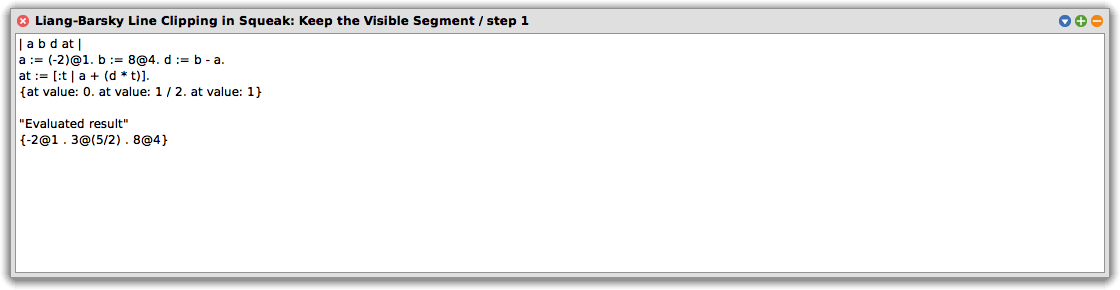
Try it: Try t = 1/10. You are still to the left of x = 0, at the point (-1)@(13/10).
02 - Rewrite each edge as p times t ≤ q
The left bound says a.x + dx·t must be at least xmin. Moving terms makes it −dx·t ≤ a.x − xmin. The right edge instead gives dx·t ≤ xmax − a.x. Repeat for y. Each pair holds p and q in the order minimum x, maximum x, minimum y, maximum y.
| a b d lo hi |
a := (-2)@1. b := 8@4. d := b - a.
lo := 0@0. hi := 6@4.
{{d x negated. a x - lo x}. {d x. hi x - a x}.
 {d y negated. a y - lo y}. {d y. hi y - a y}}
Expected: #((-10 -2) (10 8) (-3 1) (3 3))
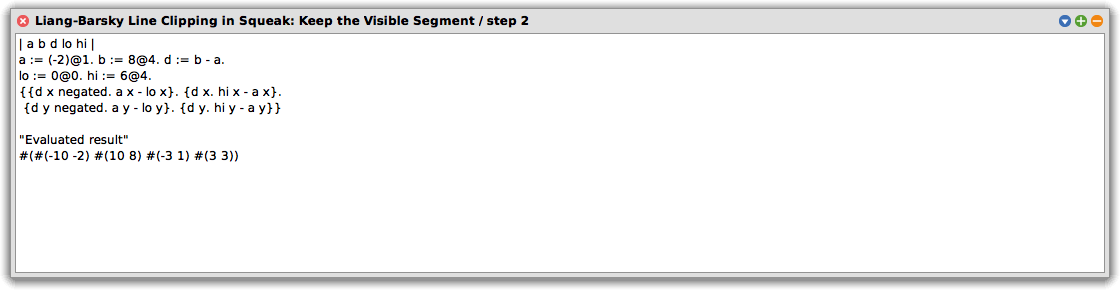
Try it: For the first pair, dividing −10·t ≤ −2 by −10 reverses the inequality, so t must be at least 1/5.
03 - Take the strongest entry and exit limits
The starting interval is [0,1], since we want a segment rather than its infinite supporting line. A negative p imposes a lower bound on t after the inequality flips; a positive p imposes an upper bound. Keep the greatest lower bound and the least upper bound. This checkpoint uses only nonzero p; the next one handles parallel edges.
| enter exit |
enter := 0. exit := 1.
#((-10 -2) (10 8) (-3 1) (3 3))
 do: [:edge | | p q t |
  p := edge first. q := edge second.
  t := q / p.
  p < 0
   ifTrue: [enter := enter max: t]
   ifFalse: [exit := exit min: t]].
{enter. exit}
Expected: {1 / 5. 4 / 5}
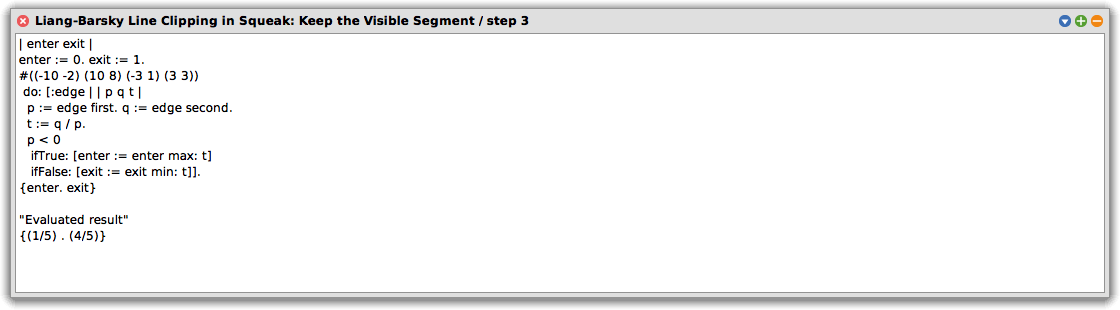
Try it: Change the second pair to (10 5). The right bound tightens, and exit becomes 1/2.
04 - Clip and reconstruct exact endpoints
A p of zero means the coordinate cannot change along this segment. If q is negative then no t could satisfy 0 ≤ q, so mark the segment outside; otherwise that edge imposes no restriction. Once all four edges are checked, reject an empty interval or turn its two limits back into Points. The first and last intersections here lie on the vertical edges, and neither y coordinate was rounded.
| clip |
clip := [:a :b :lo :hi | | d enter exit outside |
 d := b - a.
 enter := 0. exit := 1. outside := false.
 {{d x negated. a x - lo x}. {d x. hi x - a x}.
  {d y negated. a y - lo y}. {d y. hi y - a y}}
  do: [:boundary | | p q t |
   p := boundary first. q := boundary second.
   p = 0
    ifTrue: [q < 0 ifTrue: [outside := true]]
    ifFalse: [
     t := q / p.
     p < 0
      ifTrue: [enter := enter max: t]
      ifFalse: [exit := exit min: t]]].
 (outside or: [enter > exit]) ifTrue: [nil] ifFalse: [
  {a + (d * enter). a + (d * exit)}]].
clip value: (-2)@1 value: 8@4 value: 0@0 value: 6@4
Expected: {0@(8 / 5). 6@(17 / 5)}
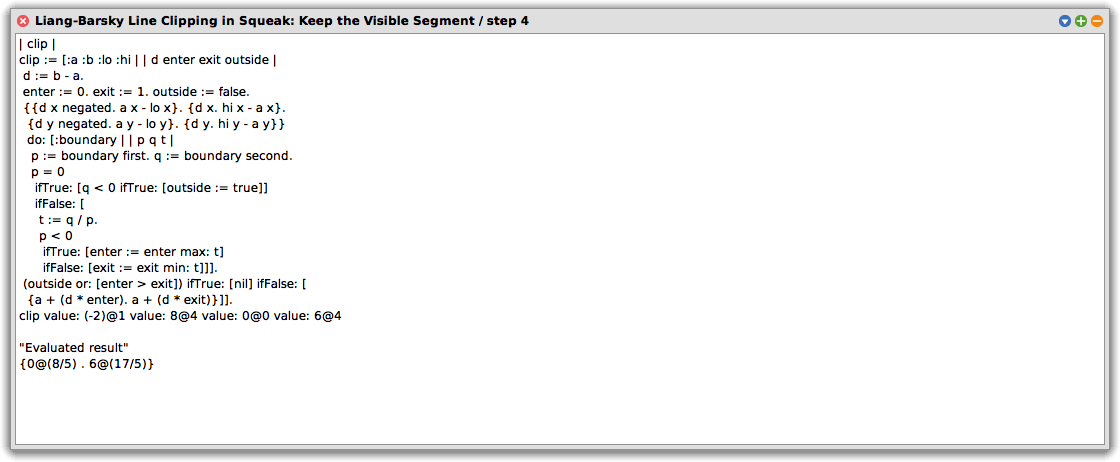
Try it: Swap A and B. You should see the same intersections in reverse order.
05 - Distinguish parallel, separated, and touching segments
The first segment stays above the window, so a parallel edge rejects it. The second heads toward the window but stops short: its required entry t is greater than one, so enter exceeds exit. The third can touch only the shared corner at 0@0. Equal entry and exit limits are valid and describe a one-point intersection.
| clip |
clip := [:a :b :lo :hi | | d enter exit outside |
 d := b - a.
 enter := 0. exit := 1. outside := false.
 {{d x negated. a x - lo x}. {d x. hi x - a x}.
  {d y negated. a y - lo y}. {d y. hi y - a y}}
  do: [:boundary | | p q t |
   p := boundary first. q := boundary second.
   p = 0
    ifTrue: [q < 0 ifTrue: [outside := true]]
    ifFalse: [
     t := q / p.
     p < 0
      ifTrue: [enter := enter max: t]
      ifFalse: [exit := exit min: t]]].
 (outside or: [enter > exit]) ifTrue: [nil] ifFalse: [
  {a + (d * enter). a + (d * exit)}]].
{clip value: (-2)@5 value: 8@5 value: 0@0 value: 6@4.
 clip value: (-3)@1 value: (-2)@2 value: 0@0 value: 6@4.
 clip value: (-2)@2 value: 2@(-2) value: 0@0 value: 6@4}
Expected: {nil. nil. {0@0. 0@0}}
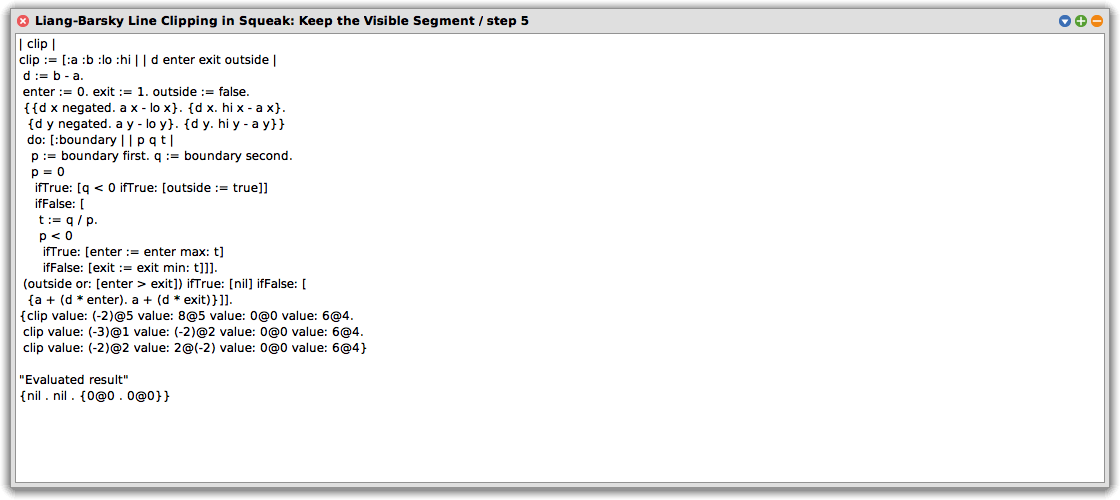
Try it: Slide the first segment to y = 4. Parallel to that edge now means on it, and the segment clips to the top boundary of the coordinate range.
06 - Treat a zero-length segment as a point
All four p values are zero when A equals B. An inside or boundary point satisfies every fixed inequality and comes back as two identical endpoints. An outside point violates at least one of those inequalities, so clipping returns nil. The caller can draw an explicit pixel or marker if it wants point intersections to be visible.
| clip |
clip := [:a :b :lo :hi | | d enter exit outside |
 d := b - a.
 enter := 0. exit := 1. outside := false.
 {{d x negated. a x - lo x}. {d x. hi x - a x}.
  {d y negated. a y - lo y}. {d y. hi y - a y}}
  do: [:boundary | | p q t |
   p := boundary first. q := boundary second.
   p = 0
    ifTrue: [q < 0 ifTrue: [outside := true]]
    ifFalse: [
     t := q / p.
     p < 0
      ifTrue: [enter := enter max: t]
      ifFalse: [exit := exit min: t]]].
 (outside or: [enter > exit]) ifTrue: [nil] ifFalse: [
  {a + (d * enter). a + (d * exit)}]].
{clip value: 3@2 value: 3@2 value: 0@0 value: 6@4.
 clip value: 6@4 value: 6@4 value: 0@0 value: 6@4.
 clip value: 7@2 value: 7@2 value: 0@0 value: 6@4}
Expected: {{3@2. 3@2}. {6@4. 6@4}. nil}
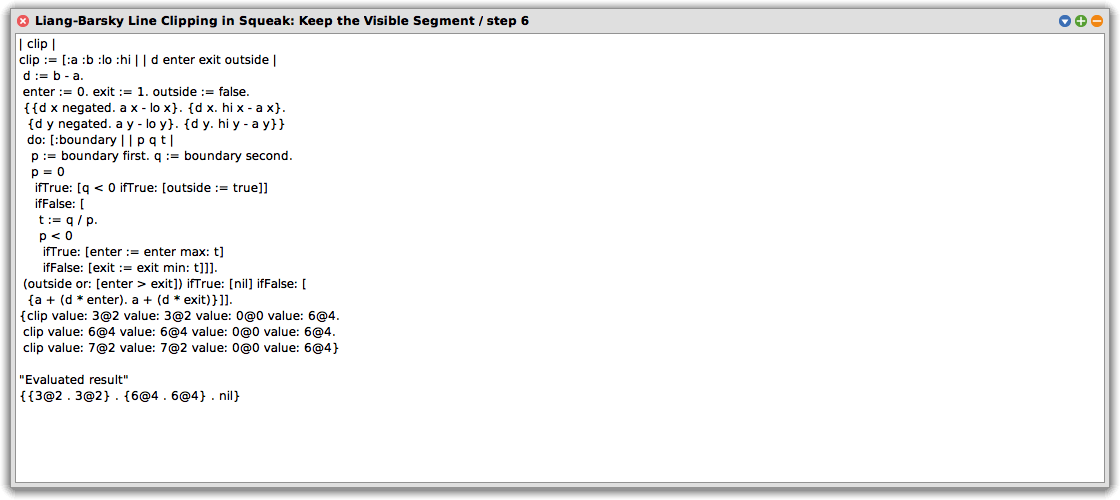
Try it: Try 0@2 twice. Because the limits are inclusive, a point on the side is also retained.
Replay the checkpoints
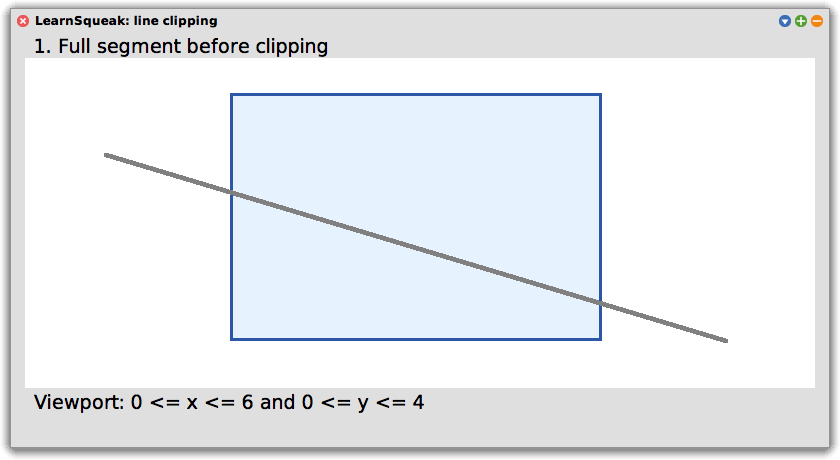
See the viewport trim the line
Reason about correctness and limits
Smalltalk’s binary messages share one precedence and run left to right. Write a + (d * t), not a + d * t; write 0@(8 / 5) when constructing a point with a fractional y coordinate.
Only divide by p when it is nonzero. In nearly parallel floating-point data, a small nonzero p is still meaningful, especially on long segments. Define a tolerance for your own coordinate scale rather than replacing the exact zero test blindly.
These are inclusive coordinate bounds, independent of which way y increases on screen. For a pixel buffer indexed from 0, the last valid x is width − 1, not width. Clip before choosing how to round for raster drawing.
Clipping keeps a subset of the original segment. It does not clip curved paths or arbitrary polygon outlines, and it assumes correctly ordered limits. A rectangle with zero width or height is allowed, but may leave only a segment or a point.
Three practice challenges
Keep a segment on the edge
What should the full clip block return for A = (-2)@0 and B = 8@0 in the same viewport?
Show solution
{0@0. 6@0}. The y coordinate stays on a valid boundary and imposes no extra constraint.
Check a vertical crossing
Clip 3@(-2) to 3@6 against limits 0@0 and 6@4. Which constraints become parallel?
Show solution
Both x constraints have p = 0 and their q values are nonnegative. The result is {3@0. 3@4}, with entry 1/4 and exit 3/4.
Recognize an entirely visible path
For A = 1@1 and B = 5@3 inside the same rectangle, what is the final t interval?
Show solution
[0,1]. No edge tightens either bound, so the original endpoints are returned unchanged.
Continue learning
Bresenham Lines | Barycentric Triangle | Affine Transforms
Environment reference: official Squeak documentation. This lesson and its examples are original. Verified using native Squeak 6.1 build 23976 on Linux.