SMALLTALK LAB
Rank and unrank permutations in Squeak
Find an ordering’s position without generating all the orderings before it.
Before you begin
Open a Workspace in native Squeak and use Print it on one complete checkpoint at a time.
These are native Squeak 6.1 examples. Each checkpoint is independent: open the download as text, copy one complete expression into Workspace and choose Print it. Do not file in the checkpoint collection as a class definition.
Expected values are Smalltalk expressions. The printer may display equivalent Smalltalk literals with different spaces or delimiters.
01 - Count smaller unused choices
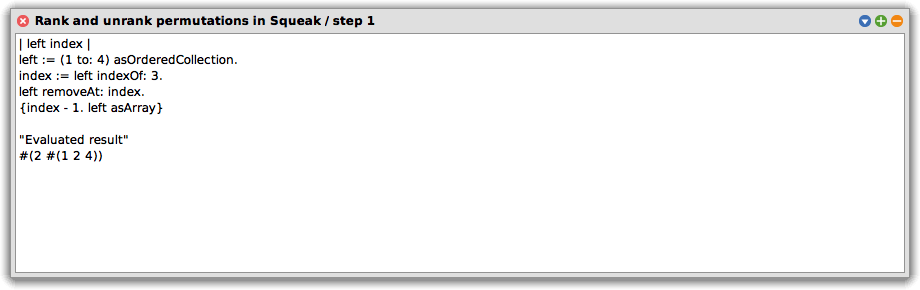
In the first slot, choosing 3 skips the two prefix groups that begin with 1 and 2. Remove 3 from the available list, and only unused choices count from now on.
| left index |
left := (1 to: 4) asOrderedCollection.
index := left indexOf: 3.
left removeAt: index.
{index - 1. left asArray}
Expected: {2. #(1 2 4)}
Try it: If the first number were 2 instead, the digit would be 1.
02 - Find the first ordering
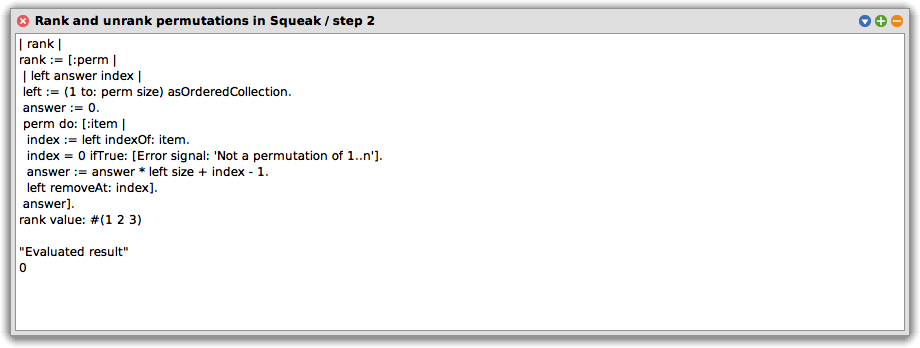
The sorted sequence always chooses the first unused number, so every digit is zero. The first rank is zero, not one.
| rank |
rank := [:perm |
 | left answer index |
 left := (1 to: perm size) asOrderedCollection.
 answer := 0.
 perm do: [:item |
  index := left indexOf: item.
  index = 0 ifTrue: [Error signal: 'Not a permutation of 1..n'].
  answer := answer * left size + index - 1.
  left removeAt: index].
 answer].
rank value: #(1 2 3)
Expected: 0
Try it: Try an empty permutation: there is one empty ordering at rank zero.
03 - Fold the slot choices into the rank
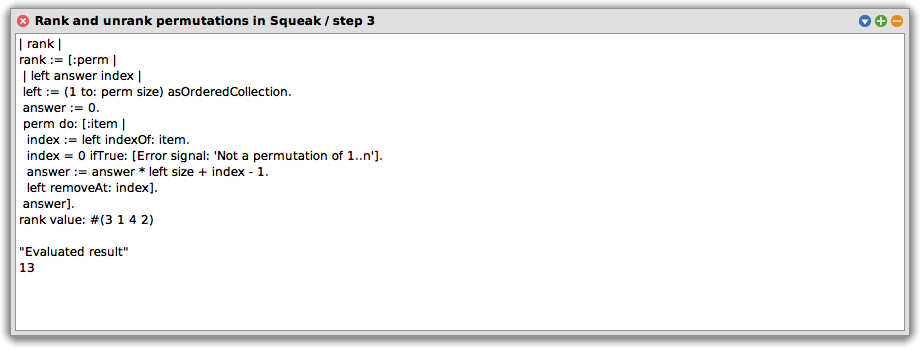
The successive zero-based choice digits are 2, 0, 1, 0. The multipliers shrink with the unused list; read another way, their factorial weights yield 2×3! + 0×2! + 1×1! + 0×0! = 13.
| rank |
rank := [:perm |
 | left answer index |
 left := (1 to: perm size) asOrderedCollection.
 answer := 0.
 perm do: [:item |
  index := left indexOf: item.
  index = 0 ifTrue: [Error signal: 'Not a permutation of 1..n'].
  answer := answer * left size + index - 1.
  left removeAt: index].
 answer].
rank value: #(3 1 4 2)
Expected: 13
Try it: The place at which you choose 4 from #(2 4) contributes one to the rank.
04 - Reverse the calculation by skipping blocks
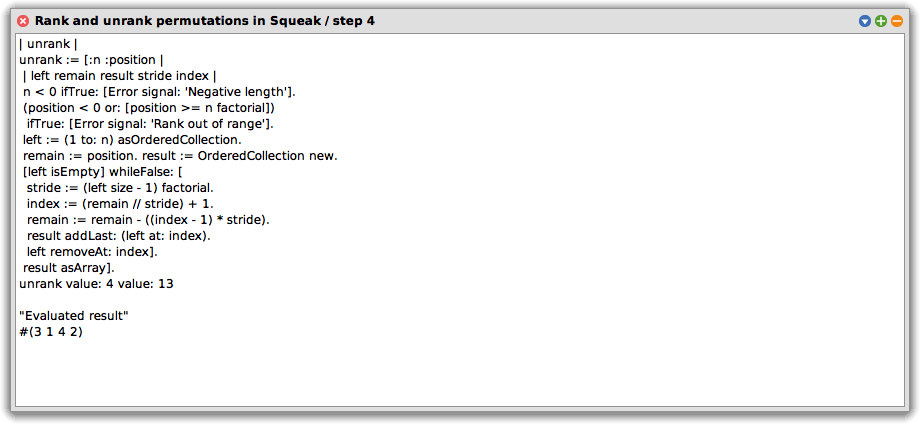
The first block size is 3! = 6. Rank 13 skips two complete blocks, chooses 3, and leaves one to resolve among permutations of the other numbers.
| unrank |
unrank := [:n :position |
 | left remain result stride index |
 n < 0 ifTrue: [Error signal: 'Negative length'].
 (position < 0 or: [position >= n factorial])
  ifTrue: [Error signal: 'Rank out of range'].
 left := (1 to: n) asOrderedCollection.
 remain := position. result := OrderedCollection new.
 [left isEmpty] whileFalse: [
  stride := (left size - 1) factorial.
  index := (remain // stride) + 1.
  remain := remain - ((index - 1) * stride).
  result addLast: (left at: index).
  left removeAt: index].
 result asArray].
unrank value: 4 value: 13
Expected: #(3 1 4 2)
Try it: After choosing 3, the next block size is 2, so remaining position 1 chooses the first unused number.
05 - Locate the final three-number ordering
Three items give six orderings. At rank 5, the division chooses the last viable number at each slot, giving descending order.
| unrank |
unrank := [:n :position |
 | left remain result stride index |
 n < 0 ifTrue: [Error signal: 'Negative length'].
 (position < 0 or: [position >= n factorial])
  ifTrue: [Error signal: 'Rank out of range'].
 left := (1 to: n) asOrderedCollection.
 remain := position. result := OrderedCollection new.
 [left isEmpty] whileFalse: [
  stride := (left size - 1) factorial.
  index := (remain // stride) + 1.
  remain := remain - ((index - 1) * stride).
  result addLast: (left at: index).
  left removeAt: index].
 result asArray].
unrank value: 3 value: 5
Expected: #(3 2 1)
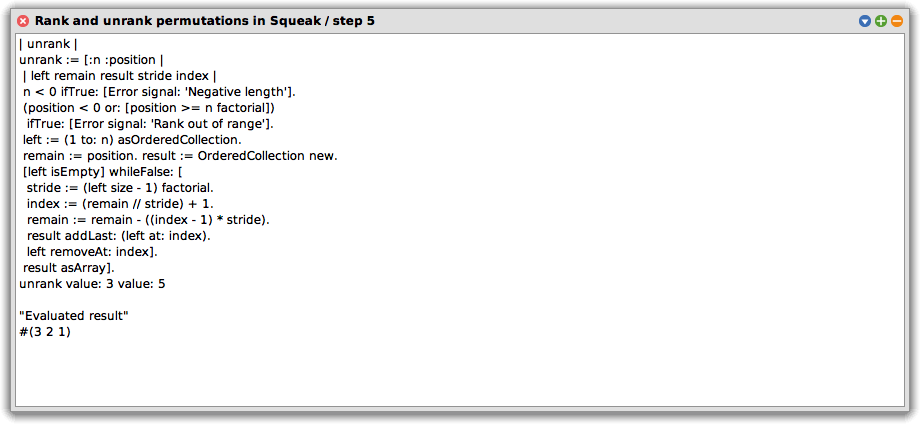
Try it: Change the rank to 0 and expect the ascending ordering.
06 - Round-trip every three-number rank
Generate an ordering for each valid position and recover its original rank. This checks all six cases of length three without asserting that a small test is a proof.
| rank unrank |
rank := [:perm |
 | left answer index |
 left := (1 to: perm size) asOrderedCollection.
 answer := 0.
 perm do: [:item |
  index := left indexOf: item.
  index = 0 ifTrue: [Error signal: 'Not a permutation of 1..n'].
  answer := answer * left size + index - 1.
  left removeAt: index].
 answer].
unrank := [:n :position |
 | left remain result stride index |
 n < 0 ifTrue: [Error signal: 'Negative length'].
 (position < 0 or: [position >= n factorial])
  ifTrue: [Error signal: 'Rank out of range'].
 left := (1 to: n) asOrderedCollection.
 remain := position. result := OrderedCollection new.
 [left isEmpty] whileFalse: [
  stride := (left size - 1) factorial.
  index := (remain // stride) + 1.
  remain := remain - ((index - 1) * stride).
  result addLast: (left at: index).
  left removeAt: index].
 result asArray].
((0 to: 5) collect: [:i | rank value: (unrank value: 3 value: i)]) asArray
Expected: #(0 1 2 3 4 5)
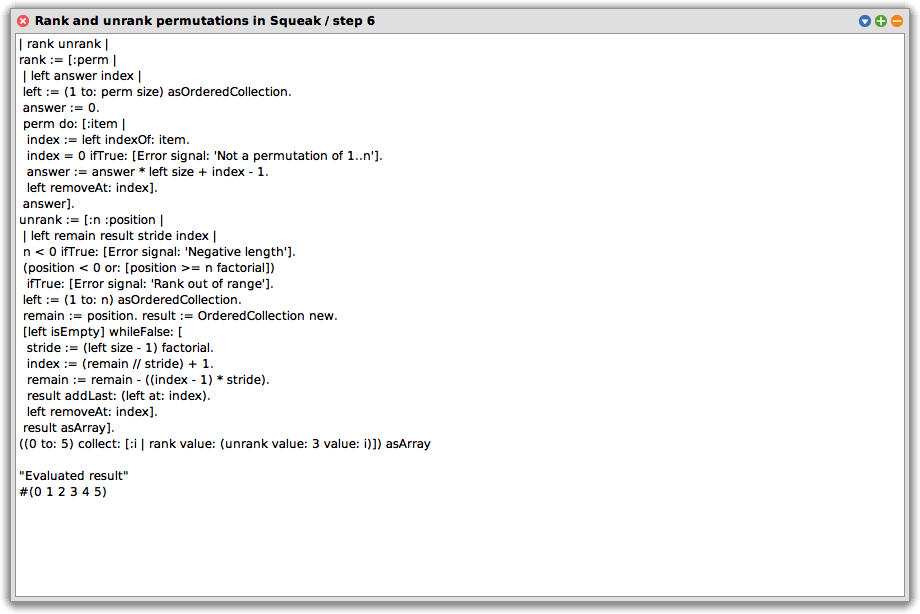
Try it: Repeat for length four and positions 0 through 23.
Replay the checkpoints
Reason about correctness and limits
Inputs to rank must contain each integer 1 through n once. To unrank, pass nonnegative integer n and integer position in [0, n factorial).
The ranking is lexicographic and zero-based. It is a position in a sorted list; Kendall distance is a disagreement measure between two orderings.
Searching and removing from the remaining list take quadratic work overall with this representation. Large factorials and repeated factorial computation also add cost.
Three practice challenges
Rank the last ordering
What is the rank of #(3 2 1)?
Show solution
5, because the lexicographically last ordering has rank 3!−1.
Check the first choice
Which number leads the length-four ordering at rank 7?
Show solution
2. The first six begin with 1, and the next six with 2.
Think in blocks
Why does a candidate prefix represent (n−1)! completions?
Show solution
Once its first number is chosen, all possible arrangements of the remaining n−1 distinct numbers are allowed.
Reference
Berger and colleagues: Lehmer code and its historical reference
Continue learning
Kendall Rank Distance | First Sorted
Environment reference: official Squeak documentation. This lesson and its examples are original. Verified using native Squeak 6.1 build 23976 on Linux.