SMALLTALK LAB
Adjacent-Swap Typo Distance in Squeak: Optimal String Alignment
Treat a neighboring-letter swap as one typo. Extend an edit-distance grid in Squeak, then find an example where the shortcut is not the full Damerau–Levenshtein distance.
Before you begin
Open a native Squeak Workspace. Each checkpoint is independent. Select the whole example, including its temporary declarations, and choose Print it.
These are native Squeak 6.1 examples. Each checkpoint is independent: open the download as text, copy one complete expression into Workspace and choose Print it. Do not file in the checkpoint collection as a class definition.
Expected values are Smalltalk expressions. The printer may show explicit Symbol markers: #(A B) and #(#A #B) represent the same array of Symbols.
01 - Recognize a pair in reverse order
The misspelling 'teh' differs from 'the' where the final two characters cross. A local test checks that each character matches the other end of the opposing pair. These two-character examples are just the detection rule, not the full distance.
| left right flipped |
flipped := [:s :t | (s first = t second) and: [s second = t first]].
left := 'he'. right := 'eh'.
{flipped value: left value: right. flipped value: left value: 'ha'}
Expected: #(true false)
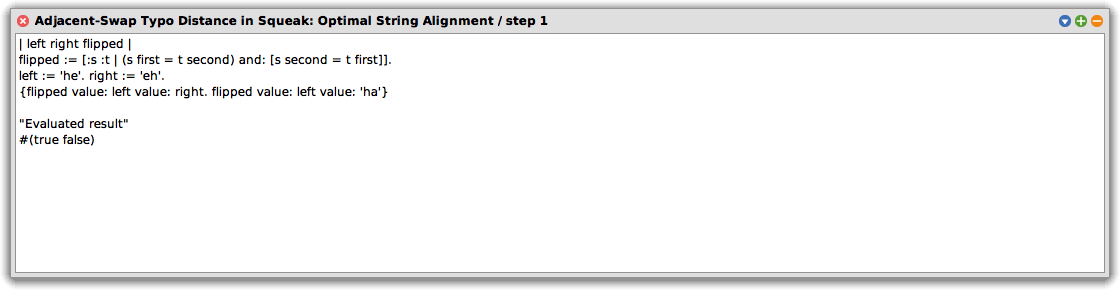
Try it: Try 'ab' against 'ba', then 'ab' against 'bc'. Only the first pair crosses.
02 - Give the empty prefixes their own cells
The grid cell for prefix lengths i and j lives at array row i + 1, column j + 1. Going from the empty source to a j-character prefix takes j insertions; going from an i-character source to the empty target takes i deletions. Each row is created separately so the cells do not share storage.
| d |
d := (1 to: 3) collect: [:row | Array new: 4].
0 to: 2 do: [:i | (d at: i + 1) at: 1 put: i].
0 to: 3 do: [:j | (d at: 1) at: j + 1 put: j].
{d at: 1. (d at: 2) at: 1. (d at: 3) at: 1}
Expected: #(#(0 1 2 3) 1 2)
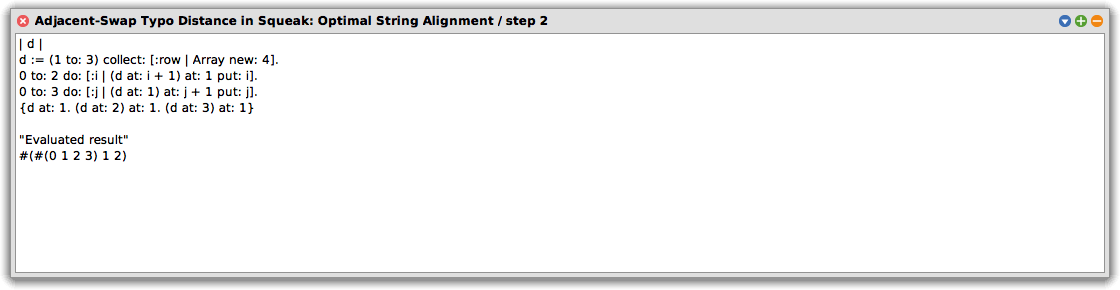
Try it: Read the first row as four distances from the empty source. The leftmost column is 0, 1, 2.
03 - Compare the same typo with and without swaps
The deletion, insertion and substitution candidates each come from the neighboring prefix cells. When both prefixes have at least two characters and their last two cross, add one more candidate from prefix lengths i - 2 and j - 2, plus the cost of one swap. Keeping the minimum preserves the ordinary edit as an option. Disable the swap branch and the very same grid computes Levenshtein distance.
| distance |
distance := [:s :t :allowSwap | | d m n |
 m := s size. n := t size.
 d := (1 to: m + 1) collect: [:row | Array new: n + 1].
 0 to: m do: [:i | (d at: i + 1) at: 1 put: i].
 0 to: n do: [:j | (d at: 1) at: j + 1 put: j].
 1 to: m do: [:i |
  1 to: n do: [:j | | cost best |
   cost := (s at: i) = (t at: j) ifTrue: [0] ifFalse: [1].
   best := (((d at: i) at: j + 1) + 1)
    min: (((d at: i + 1) at: j) + 1).
   best := best min: (((d at: i) at: j) + cost).
   (allowSwap and: [i > 1 and: [j > 1]]) ifTrue: [
    ((s at: i) = (t at: j - 1) and:
     [(s at: i - 1) = (t at: j)]) ifTrue: [
      best := best min: (((d at: i - 1) at: j - 1) + 1)]].
   (d at: i + 1) at: j + 1 put: best]].
 (d at: m + 1) at: n + 1].
{distance value: 'teh' value: 'the' value: false.
 distance value: 'teh' value: 'the' value: true}
Expected: #(2 1)
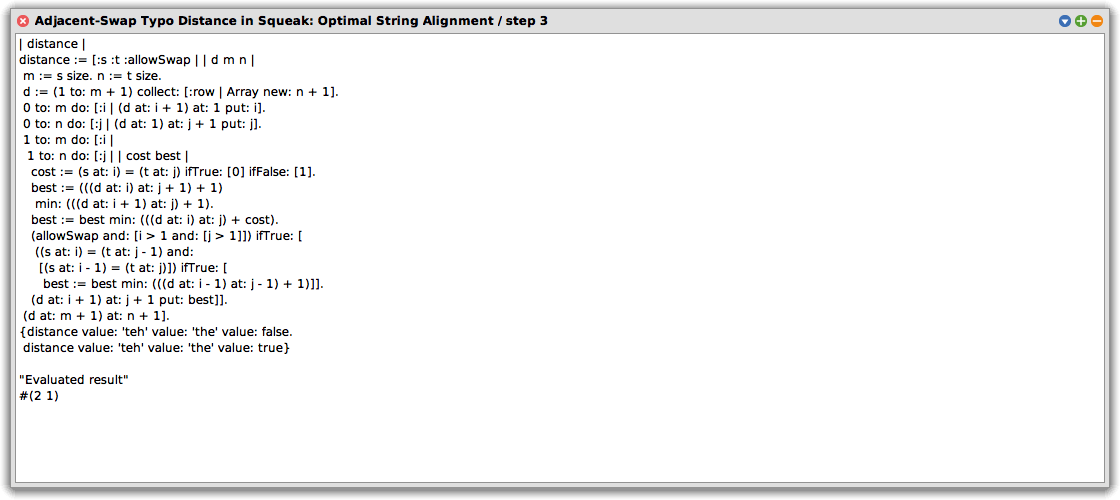
Try it: The penultimate cell references a prefix, not a zero-based character index. Translate i - 2 into array row i - 1.
04 - Combine a local swap with a separate edit
A swap can be followed by an edit to a separate portion of the alignment. The extra s in 'froms' is one insertion on top of swapping o and r; the third example uses two disjoint swaps. The grid chooses the cheapest alignment, not a prescribed order of edits.
| distance |
distance := [:s :t :allowSwap | | d m n |
 m := s size. n := t size.
 d := (1 to: m + 1) collect: [:row | Array new: n + 1].
 0 to: m do: [:i | (d at: i + 1) at: 1 put: i].
 0 to: n do: [:j | (d at: 1) at: j + 1 put: j].
 1 to: m do: [:i |
  1 to: n do: [:j | | cost best |
   cost := (s at: i) = (t at: j) ifTrue: [0] ifFalse: [1].
   best := (((d at: i) at: j + 1) + 1)
    min: (((d at: i + 1) at: j) + 1).
   best := best min: (((d at: i) at: j) + cost).
   (allowSwap and: [i > 1 and: [j > 1]]) ifTrue: [
    ((s at: i) = (t at: j - 1) and:
     [(s at: i - 1) = (t at: j)]) ifTrue: [
      best := best min: (((d at: i - 1) at: j - 1) + 1)]].
   (d at: i + 1) at: j + 1 put: best]].
 (d at: m + 1) at: n + 1].
{distance value: 'form' value: 'from' value: true.
 distance value: 'form' value: 'froms' value: true.
 distance value: 'abcd' value: 'badc' value: true}
Expected: #(1 2 2)
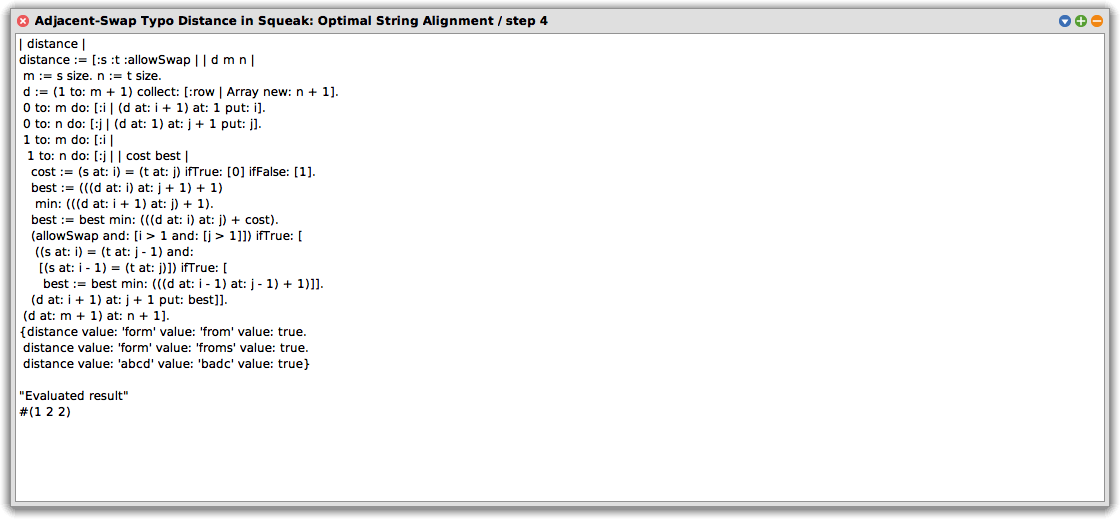
Try it: Reverse each pair and evaluate again. The same operation costs apply in either direction.
05 - Check an empty word, a match and a substitution
Empty inputs never enter the nested cell update. Identical characters can advance diagonally at zero cost, while a single different character costs one. These are useful regression tests: a swap optimization should not break the simplest inputs.
| distance |
distance := [:s :t :allowSwap | | d m n |
 m := s size. n := t size.
 d := (1 to: m + 1) collect: [:row | Array new: n + 1].
 0 to: m do: [:i | (d at: i + 1) at: 1 put: i].
 0 to: n do: [:j | (d at: 1) at: j + 1 put: j].
 1 to: m do: [:i |
  1 to: n do: [:j | | cost best |
   cost := (s at: i) = (t at: j) ifTrue: [0] ifFalse: [1].
   best := (((d at: i) at: j + 1) + 1)
    min: (((d at: i + 1) at: j) + 1).
   best := best min: (((d at: i) at: j) + cost).
   (allowSwap and: [i > 1 and: [j > 1]]) ifTrue: [
    ((s at: i) = (t at: j - 1) and:
     [(s at: i - 1) = (t at: j)]) ifTrue: [
      best := best min: (((d at: i - 1) at: j - 1) + 1)]].
   (d at: i + 1) at: j + 1 put: best]].
 (d at: m + 1) at: n + 1].
{distance value: '' value: 'cat' value: true.
 distance value: 'cat' value: '' value: true.
 distance value: 'cat' value: 'cat' value: true.
 distance value: 'cat' value: 'cot' value: true}
Expected: #(3 3 0 1)
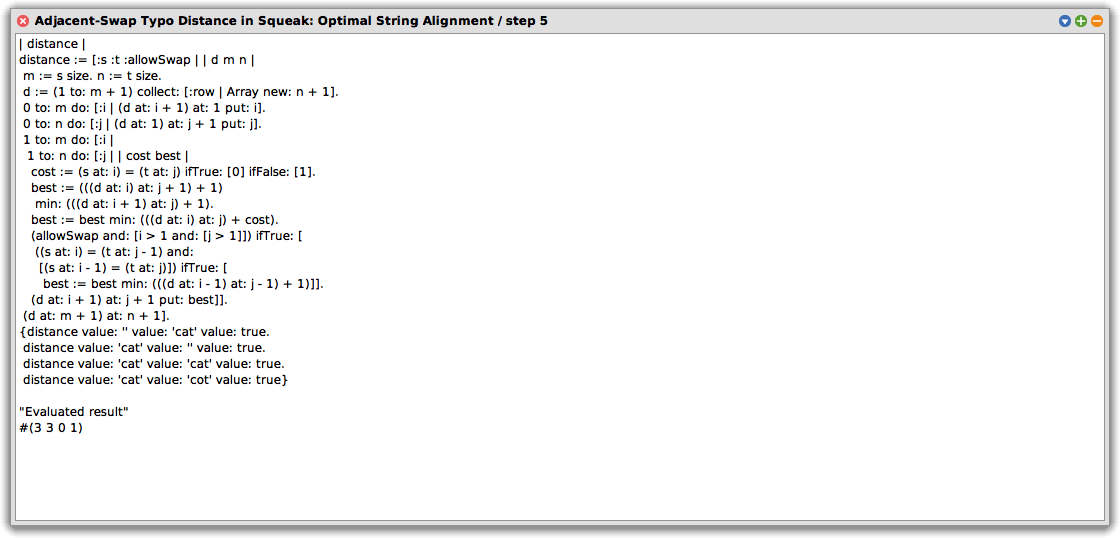
Try it: Try 'a' against 'b'. The swap branch must not read a character before the start of either string.
06 - See where the restricted distance differs
Optimal string alignment (OSA), often called restricted Damerau–Levenshtein, cannot realize a path that transposes a pair and then inserts inside that same pair. Unrestricted Damerau–Levenshtein can go CA → AC → ABC in two edits; that is optimal because the lengths differ and an insertion alone cannot reverse C and A. Here the direct OSA score is three, even though the two separate OSA scores add to two.
| distance |
distance := [:s :t :allowSwap | | d m n |
 m := s size. n := t size.
 d := (1 to: m + 1) collect: [:row | Array new: n + 1].
 0 to: m do: [:i | (d at: i + 1) at: 1 put: i].
 0 to: n do: [:j | (d at: 1) at: j + 1 put: j].
 1 to: m do: [:i |
  1 to: n do: [:j | | cost best |
   cost := (s at: i) = (t at: j) ifTrue: [0] ifFalse: [1].
   best := (((d at: i) at: j + 1) + 1)
    min: (((d at: i + 1) at: j) + 1).
   best := best min: (((d at: i) at: j) + cost).
   (allowSwap and: [i > 1 and: [j > 1]]) ifTrue: [
    ((s at: i) = (t at: j - 1) and:
     [(s at: i - 1) = (t at: j)]) ifTrue: [
      best := best min: (((d at: i - 1) at: j - 1) + 1)]].
   (d at: i + 1) at: j + 1 put: best]].
 (d at: m + 1) at: n + 1].
{distance value: 'CA' value: 'AC' value: true.
 distance value: 'AC' value: 'ABC' value: true.
 distance value: 'CA' value: 'ABC' value: true}
Expected: #(1 1 3)
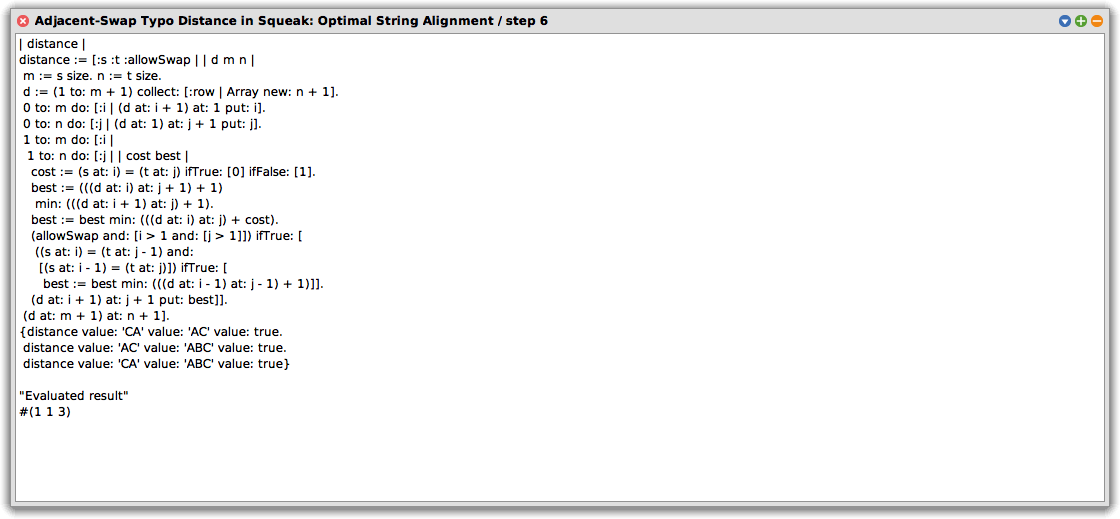
Try it: Use this triple as a reminder not to assume the triangle inequality when choosing a search index for OSA.
Replay the checkpoints
Reason about correctness and limits
This implementation fills (m + 1) × (n + 1) cells, so time and storage are both O(mn) for nonempty strings of lengths m and n. Bound input size before using the full grid to score a large dictionary; if only the score is needed, a rolling three-row version can retain the two-row-back swap dependency.
Character equality here is exact and case-sensitive. Decide whether to normalize case and Unicode before scoring user text. The example operates on Squeak String characters, not grapheme clusters.
The transposition shortcut makes neighboring swaps inexpensive, not arbitrary rearrangements. Use unrestricted Damerau–Levenshtein if editing within a previously transposed pair is part of the intended semantics.
Three practice challenges
Rank an easy typo
Which is closer to 'teh' under OSA, 'the' or 'ten'?
Show solution
They tie at one edit: one swap versus one substitution. Ranking ties requires another signal, such as frequency.
One character cannot swap
What should the solver return for 'a' and 'ba'?
Show solution
One, by inserting b at the beginning. At least two characters are needed in each prefix to consider a swap.
Inspect the finishing move
With swaps enabled, where does the winning swap candidate for 'ab' → 'ba' come from?
Show solution
The cell for two empty prefixes, at row 1 column 1. Its cost is zero, so adding the swap yields one.
Continue learning
Edit Distance | Kmp Search | Palindrome Table
Environment reference: official Squeak documentation. This lesson and its examples are original. Verified using native Squeak 6.1 build 23976 on Linux.