SMALLTALK LAB
Continued fractions: turn a ratio into a short recipe
Extract integer parts and reciprocals, rebuild exact ratios, and examine convergents using Squeak’s exact Fraction arithmetic.
Before you begin
Know fractions, loops and blocks. A finite simple continued fraction [a0; a1, a2, ...] means a0 + 1/(a1 + 1/(a2 + ...)). We use nonnegative exact rational values.
These are native Squeak 6.1 examples. Each checkpoint is independent: open the download as text, copy one complete expression into Workspace and choose Print it. Do not file in the checkpoint collection as a class definition.
01 - Separate the whole part
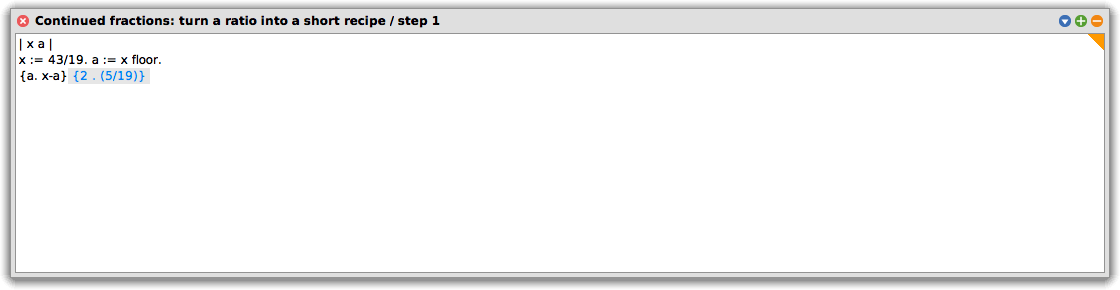
The floor is the first term. Subtract it to leave a fractional remainder. Here 43/19 begins with two and leaves 5/19.
| x a |
x := 43/19. a := x floor.
{a. x-a}
Expected: {2. 5/19.}
Try it: The remainder is at least zero and below one.
02 - Invert the remainder
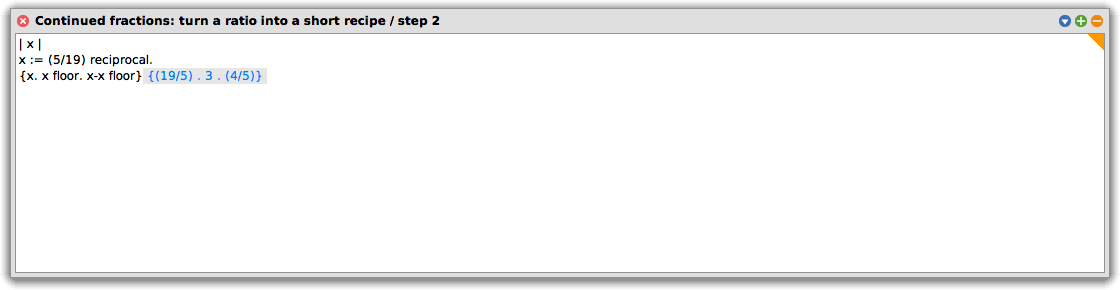
Taking the reciprocal moves the remainder into the next whole-part extraction. The reciprocal of 5/19 is 19/5, whose floor is three.
| x |
x := (5/19) reciprocal.
{x. x floor. x-x floor}
Expected: {19/5. 3. 4/5.}
Try it: Never invert zero; zero means the expansion is complete.
03 - Extract every term
Repeat whole-part extraction until the remainder becomes zero. The loop condition also performs the extraction, so even an integer receives a one-term result. Exact rational arithmetic guarantees finite termination for these inputs.
| terms |
terms := [:value | | x out a |
 (value isInteger or: [value isKindOf: Fraction])
  ifFalse: [Error signal: 'Use an exact rational'].
 value < 0 ifTrue: [Error signal: 'Use a nonnegative rational'].
 x := value. out := OrderedCollection new.
 [a := x floor. out add: a. x := x-a. x = 0]
  whileFalse: [x := x reciprocal].
 out asArray].
terms value: 43/19
Expected: {2. 3. 1. 4.}
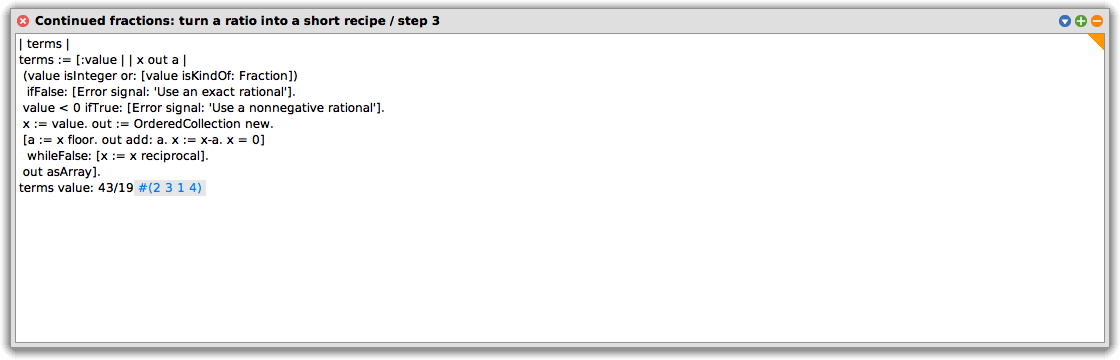
Try it: Follow the remainders manually: 5/19, 4/5, 1/4, then zero.
04 - Handle integers and zero
A whole number has no fractional remainder. Zero is also a valid one-term continued fraction. These cases test the termination check before any reciprocal operation.
| terms |
terms := [:value | | x out a |
 (value isInteger or: [value isKindOf: Fraction])
  ifFalse: [Error signal: 'Use an exact rational'].
 value < 0 ifTrue: [Error signal: 'Use a nonnegative rational'].
 x := value. out := OrderedCollection new.
 [a := x floor. out add: a. x := x-a. x = 0]
  whileFalse: [x := x reciprocal].
 out asArray].
{terms value: 7. terms value: 0}
Expected: {#(7). #(0)}
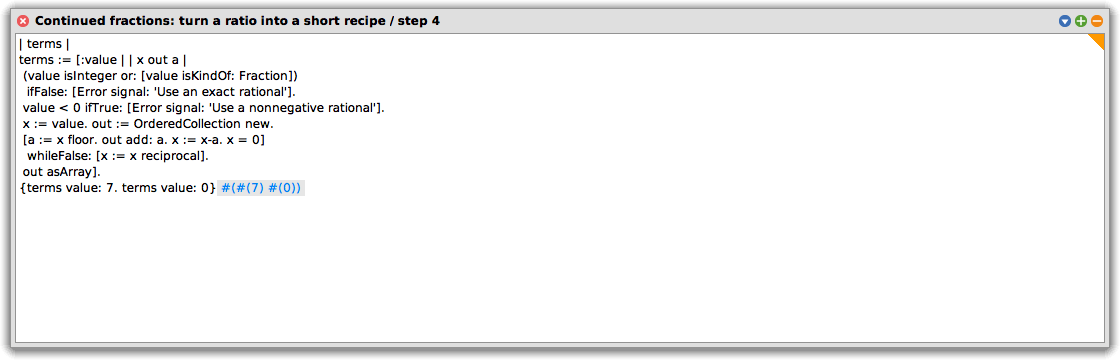
Try it: No reciprocal of zero occurs in either expansion.
05 - Rebuild from the right
Start at the final term. Walking backward, take the reciprocal of the current result and add the preceding term. The array here comes from the extractor and has valid positive tail terms.
| rebuild |
rebuild := [:sequence | | result |
 sequence isEmpty ifTrue: [Error signal: 'Supply at least one term'].
 result := sequence last.
 sequence size-1 to: 1 by: -1 do: [:i |
  result := (sequence at: i)+result reciprocal].
 result].
rebuild value: #(2 3 1 4)
Expected: 43/19
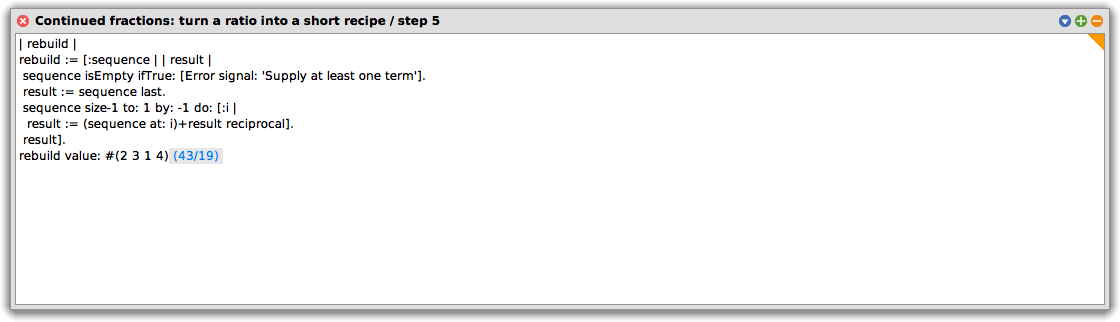
Try it: Rebuilding arbitrary unvalidated arrays can divide by zero; validate a public input format.
06 - Compare successive convergents
A prefix of the terms gives a convergent. These prefixes approach the target but need not approach from only one side. The last prefix equals the original rational exactly.
| rebuild items |
rebuild := [:sequence | | result |
 sequence isEmpty ifTrue: [Error signal: 'Supply at least one term'].
 result := sequence last.
 sequence size-1 to: 1 by: -1 do: [:i |
  result := (sequence at: i)+result reciprocal].
 result].
items := #(2 3 1 4).
(1 to: items size) collect: [:n | rebuild value: (items copyFrom: 1 to: n)]
Expected: {2. 7/3. 9/4. 43/19.}
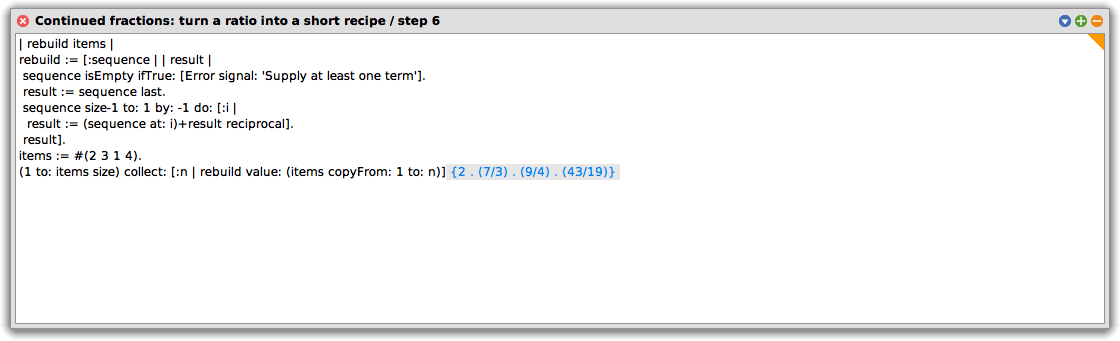
Try it: Subtract 43/19 from each result to see the alternating error signs in this example.
07 - Round-trip many exact ratios
Compare extraction followed by rebuilding across a grid of numerators and denominators. Squeak automatically reduces fractions, so mathematically equal ratios compare equal.
| terms rebuild |
terms := [:value | | x out a |
 (value isInteger or: [value isKindOf: Fraction])
  ifFalse: [Error signal: 'Use an exact rational'].
 value < 0 ifTrue: [Error signal: 'Use a nonnegative rational'].
 x := value. out := OrderedCollection new.
 [a := x floor. out add: a. x := x-a. x = 0]
  whileFalse: [x := x reciprocal].
 out asArray].
rebuild := [:sequence | | result |
 sequence isEmpty ifTrue: [Error signal: 'Supply at least one term'].
 result := sequence last.
 sequence size-1 to: 1 by: -1 do: [:i |
  result := (sequence at: i)+result reciprocal].
 result].
(0 to: 20) allSatisfy: [:n |
 (1 to: 12) allSatisfy: [:d |
  (rebuild value: (terms value: n/d)) = (n/d)]]
Expected: true
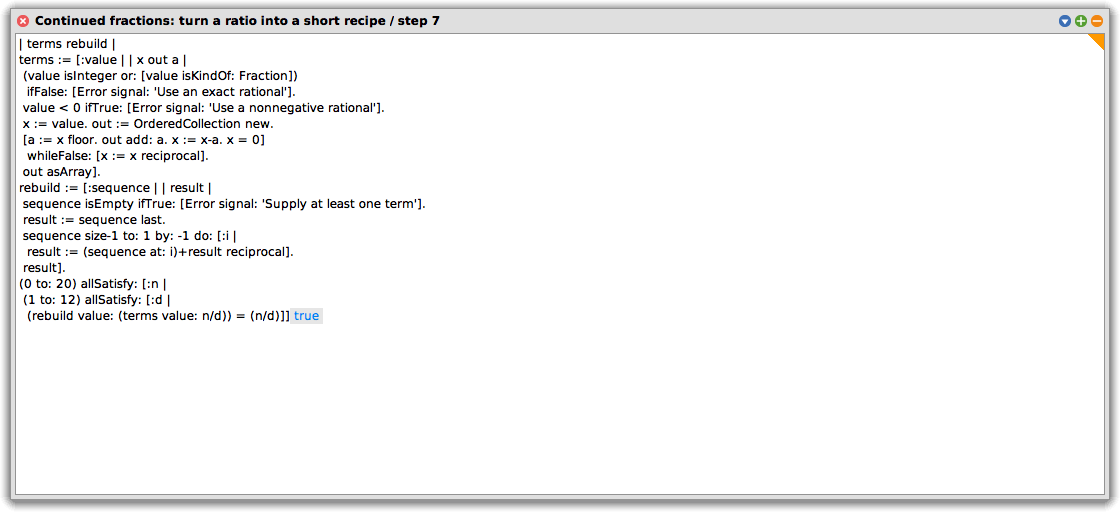
Try it: Include larger coprime numerator and denominator values as additional checks.
08 - Reject floating-point input
A Float is an approximation and is deliberately outside this extractor's contract. Without a precision policy, a decimal approximation may create a long expansion that looks more meaningful than it is.
| terms |
terms := [:value | | x out a |
 (value isInteger or: [value isKindOf: Fraction])
  ifFalse: [Error signal: 'Use an exact rational'].
 value < 0 ifTrue: [Error signal: 'Use a nonnegative rational'].
 x := value. out := OrderedCollection new.
 [a := x floor. out add: a. x := x-a. x = 0]
  whileFalse: [x := x reciprocal].
 out asArray].
[terms value: 2.5. false]
 on: Error do: [:e | e messageText = 'Use an exact rational']
Expected: true
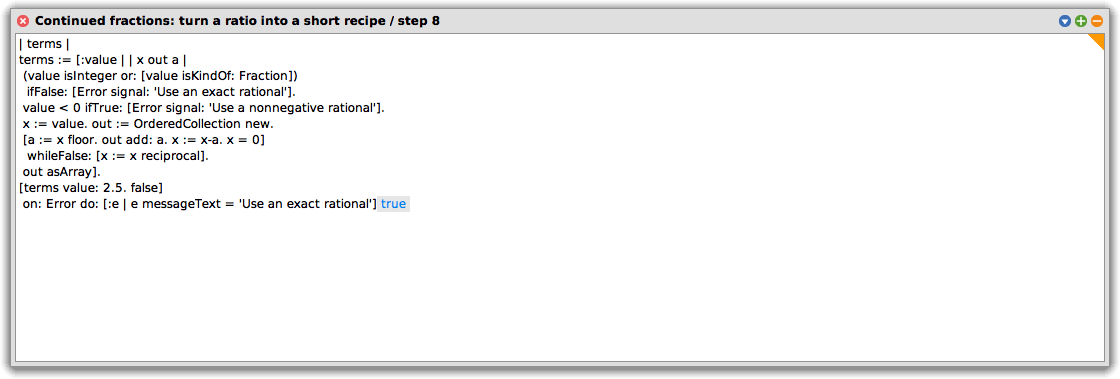
Try it: Use the exact fraction 5/2 instead; its terms are #(2 2).
Watch the computed states
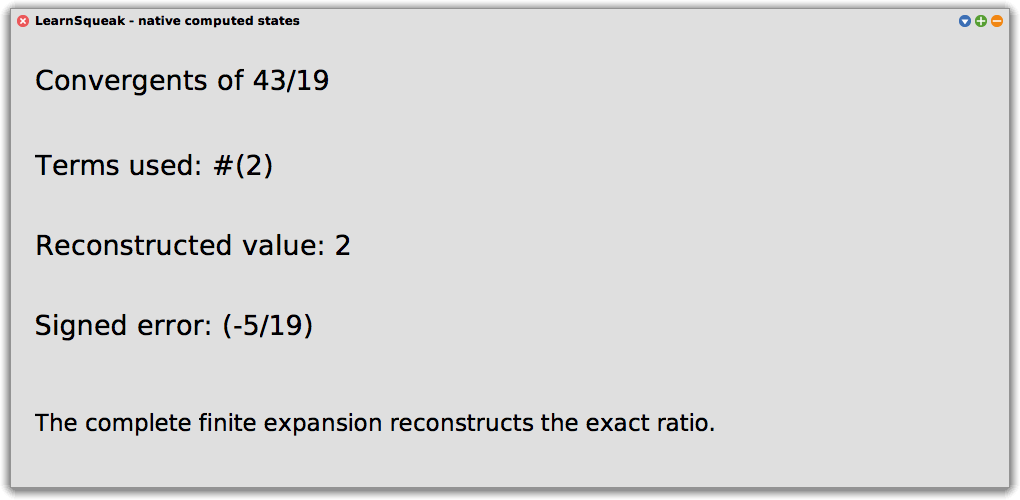
Download the visual experiment. Select the entire expression and Do it. Change stage := 0. to another supported stage, close the previous window, and run again. The GIF replays those native states. This example needs native Squeak; no new browser playground compatibility is claimed.
Reason about correctness and limits
The algorithm is closely related to Euclid’s repeated division, but records the quotients to describe a rational rather than only compute a gcd. Its number of terms depends on the ratio; large integer arithmetic contributes additional cost.
This lesson does not approximate irrational numbers or promise an error bound for Float input. An irrational expansion is generally infinite and needs an explicit stopping rule.
A rational may have two finite simple expansions, such as [2; 2] and [2; 1, 1]. This extraction ends naturally on a final integer; compare reconstructed values rather than assuming every possible notation is unique.
Three practice challenges
Challenge 1
What is the continued fraction of 5/2?
Show solution
The whole part is two; the remaining half becomes two after inversion. The result is #(2 2).
Challenge 2
Why rebuild from the right?
Show solution
The final reciprocal is nested deepest. Evaluating from that inside value outward follows the mathematical parentheses.
Challenge 3
Can a final term of zero be accepted blindly?
Show solution
No. It can cause a reciprocal of zero during reconstruction. Validate arbitrary term arrays; the tested extractor produces valid tails.
Continue learning
Fractions | Euclidean Gcd | Bisection
Environment reference: official Squeak documentation. This lesson and its examples are original. Verified using native Squeak 6.1 build 23976 on Linux.