THE HISTORY OF A LIVING SYSTEM
Smalltalk roots
Before Squeak: personal computing, a programmable medium, and a system built around live objects.
A four-part history
Follow the people, ideas and engineering decisions behind the system you are learning. Dates refer to the historical event or release, not the date an archive was scanned. This is a selective introduction, with links to first-hand papers, preserved announcements and project documentation.
A computer people could shape
Alan Kay’s 1972 paper imagined a portable computer that children and adults could use to create, explore and communicate. The proposal was about a medium for expression, not merely a cheaper machine for delivering predetermined lessons. It discussed the learning environment and the activities people might construct with it. The Dynabook was a research vision; treating it as a shipped 1972 tablet would confuse an ambition with a product.
Alan Kay, A Personal Computer for Children of All Ages (1972)
This gives a useful question to carry into Squeak: can the person using a tool also inspect and change how that tool works? The tutorials here answer that question with small experiments. The historical motivation was much broader than any single demo or programming exercise.
Smalltalk was several evolving systems
At Xerox PARC, the Learning Research Group developed Smalltalk as a language, programming environment and graphical interface. Alan Kay supplied a central vision, while Dan Ingalls led important implementation and design work. Smalltalk-72, Smalltalk-74, Smalltalk-76 and Smalltalk-80 were successive designs, not just modern point releases. Smalltalk-76 introduced a form much closer to the class-and-message systems familiar today. Smalltalk-80 helped carry the work beyond PARC.
Computer History Museum: Introducing the Smalltalk Zoo
Kay’s later historical account traces influences from interactive computing, graphics and simulation. Read it as a participant’s explanation of how ideas changed through experiments. It is especially helpful for avoiding the idea that object orientation began as a checklist of language features. The environment, its users and the way programs were changed were part of the research problem.
Making a system available required more than code
The public Smalltalk-80 effort involved both engineering and communication. Adele Goldberg led work to make the system known and available outside PARC; Ingalls led development of that public version. Tektronix, DEC, Apple and HP participated in bringing it to other machines. Documentation, ports and a consistent representation mattered alongside language design. The museum’s account places these contributions in the same story rather than assigning the whole achievement to one person.
Experience an old system on its own terms
The Smalltalk Zoo, curated by Dan Ingalls and hosted by the Computer History Museum, preserves runnable artifacts and related papers. Its exhibits include Smalltalk-72, Smalltalk-78, Smalltalk-80, Squeak and Etoys. These browser simulations are a better way to investigate an old interaction than assuming a current Squeak screenshot is historical evidence. The site also identifies gaps in some reconstructions, such as missing facilities in particular early systems.
Dan Ingalls’s Smalltalk Zoo at the Computer History Museum
Try comparing how you select code, open a browser and inspect an object. Look for continuity in the style of work, then notice where the actual interface differs. For present-day practice, continue with Squeak’s development tools and reading the system’s own source.
Read the evidence
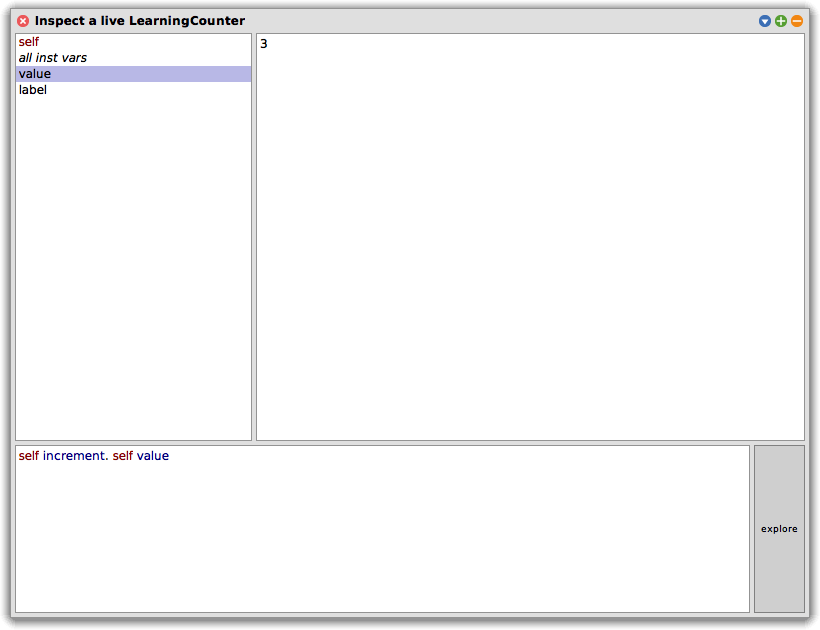
These pages paraphrase the sources and connect them to the practical lessons on this site. They do not reproduce historical screenshots or claim that today’s interface looked the same in an earlier release. Primary accounts are valuable, but each describes a particular time and point of view. Compare the paper, release notes and running system when a detail matters.