SMALLTALK LAB
Calculate an initial great-circle bearing in Squeak
Find the direction to leave on a spherical route, measured clockwise from north.
Before you begin
Open a Workspace in native Squeak and use Print it on one complete checkpoint at a time.
These are native Squeak 6.1 examples. Each checkpoint is independent: open the download as text, copy one complete expression into Workspace and choose Print it. Do not file in the checkpoint collection as a class definition.
Expected values are Smalltalk expressions. The printer may display equivalent Smalltalk literals with different spaces or delimiters.
01 - Convert angular input to radians
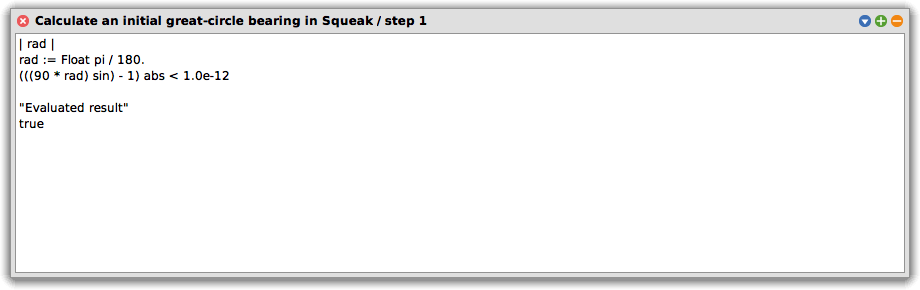
Use radians for the trigonometric messages. A quarter turn has sine 1.
| rad |
rad := Float pi / 180.
(((90 * rad) sin) - 1) abs < 1.0e-12
Expected: true
Try it: Change 90 to 0 and check against sine 0.
02 - Separate the east and north components
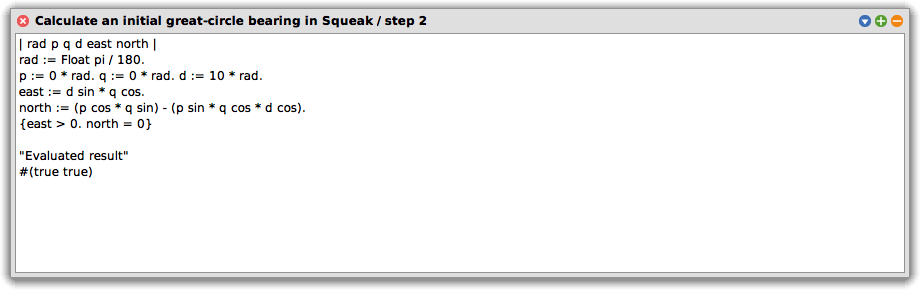
The formulas describe the initial direction as an east component and a north component. On the equator, traveling ten degrees east has no north component.
| rad p q d east north |
rad := Float pi / 180.
p := 0 * rad. q := 0 * rad. d := 10 * rad.
east := d sin * q cos.
north := (p cos * q sin) - (p sin * q cos * d cos).
{east > 0. north = 0}
Expected: #(true true)
Try it: Use a negative longitude difference to make the east component negative.
03 - Use the correct quadrant
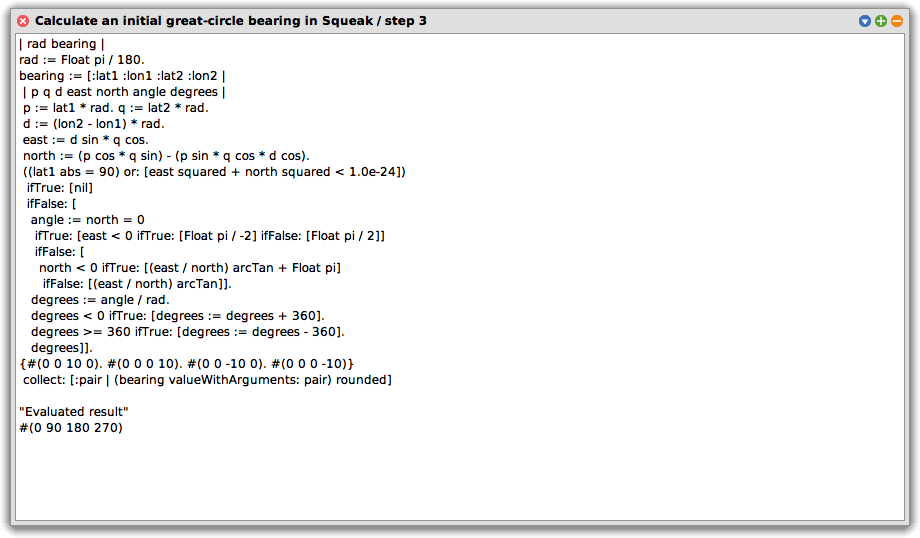
The ratio east/north alone cannot tell opposite directions apart. Use the sign of north to correct the arctangent and handle north = 0 explicitly.
| rad bearing |
rad := Float pi / 180.
bearing := [:lat1 :lon1 :lat2 :lon2 |
 | p q d east north angle degrees |
 p := lat1 * rad. q := lat2 * rad.
 d := (lon2 - lon1) * rad.
 east := d sin * q cos.
 north := (p cos * q sin) - (p sin * q cos * d cos).
 ((lat1 abs = 90) or: [east squared + north squared < 1.0e-24])
  ifTrue: [nil]
  ifFalse: [
   angle := north = 0
    ifTrue: [east < 0 ifTrue: [Float pi / -2] ifFalse: [Float pi / 2]]
    ifFalse: [
     north < 0 ifTrue: [(east / north) arcTan + Float pi]
      ifFalse: [(east / north) arcTan]].
   degrees := angle / rad.
   degrees < 0 ifTrue: [degrees := degrees + 360].
   degrees >= 360 ifTrue: [degrees := degrees - 360].
   degrees]].
{#(0 0 10 0). #(0 0 0 10). #(0 0 -10 0). #(0 0 0 -10)}
 collect: [:pair | (bearing valueWithArguments: pair) rounded]
Expected: #(0 90 180 270)
Try it: Compare the four results with a north-up compass.
04 - Reverse a route and cross the date line
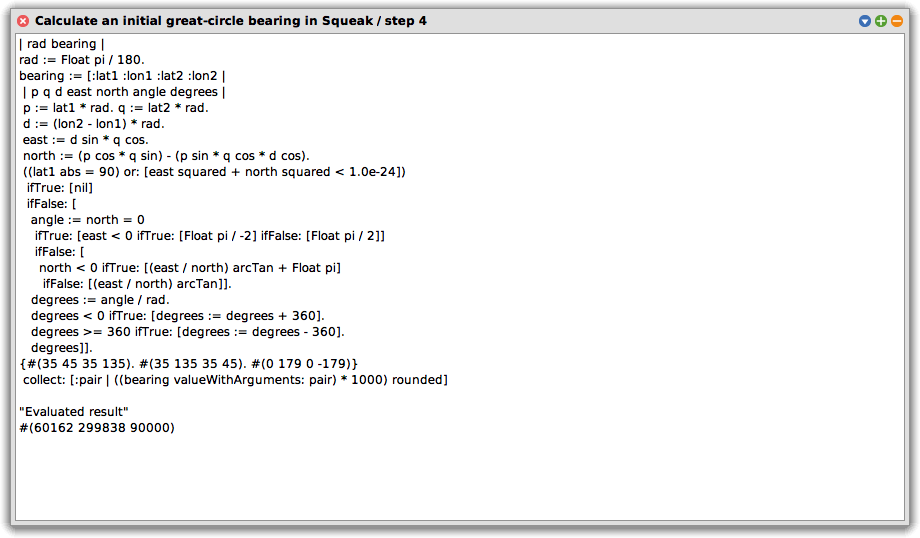
Read the results as thousandths of a degree. The two high-latitude initial headings are about 60.162° and 299.838°; the date-line route starts due east, even though the written longitude difference is negative.
| rad bearing |
rad := Float pi / 180.
bearing := [:lat1 :lon1 :lat2 :lon2 |
 | p q d east north angle degrees |
 p := lat1 * rad. q := lat2 * rad.
 d := (lon2 - lon1) * rad.
 east := d sin * q cos.
 north := (p cos * q sin) - (p sin * q cos * d cos).
 ((lat1 abs = 90) or: [east squared + north squared < 1.0e-24])
  ifTrue: [nil]
  ifFalse: [
   angle := north = 0
    ifTrue: [east < 0 ifTrue: [Float pi / -2] ifFalse: [Float pi / 2]]
    ifFalse: [
     north < 0 ifTrue: [(east / north) arcTan + Float pi]
      ifFalse: [(east / north) arcTan]].
   degrees := angle / rad.
   degrees < 0 ifTrue: [degrees := degrees + 360].
   degrees >= 360 ifTrue: [degrees := degrees - 360].
   degrees]].
{#(35 45 35 135). #(35 135 35 45). #(0 179 0 -179)}
 collect: [:pair | ((bearing valueWithArguments: pair) * 1000) rounded]
Expected: #(60162 299838 90000)
Try it: The sine and cosine are periodic, so subtracting the longitudes across the date line does not require a special crossing case.
05 - Reject ambiguous routes
Coincident locations offer no direction. Antipodes have infinitely many shortest great circles. At a departure pole this lesson does not choose a convention.
| rad bearing |
rad := Float pi / 180.
bearing := [:lat1 :lon1 :lat2 :lon2 |
 | p q d east north angle degrees |
 p := lat1 * rad. q := lat2 * rad.
 d := (lon2 - lon1) * rad.
 east := d sin * q cos.
 north := (p cos * q sin) - (p sin * q cos * d cos).
 ((lat1 abs = 90) or: [east squared + north squared < 1.0e-24])
  ifTrue: [nil]
  ifFalse: [
   angle := north = 0
    ifTrue: [east < 0 ifTrue: [Float pi / -2] ifFalse: [Float pi / 2]]
    ifFalse: [
     north < 0 ifTrue: [(east / north) arcTan + Float pi]
      ifFalse: [(east / north) arcTan]].
   degrees := angle / rad.
   degrees < 0 ifTrue: [degrees := degrees + 360].
   degrees >= 360 ifTrue: [degrees := degrees - 360].
   degrees]].
{#(1 2 1 2). #(0 0 0 180). #(90 0 10 10)}
 collect: [:pair | bearing valueWithArguments: pair]
Expected: #(nil nil nil)
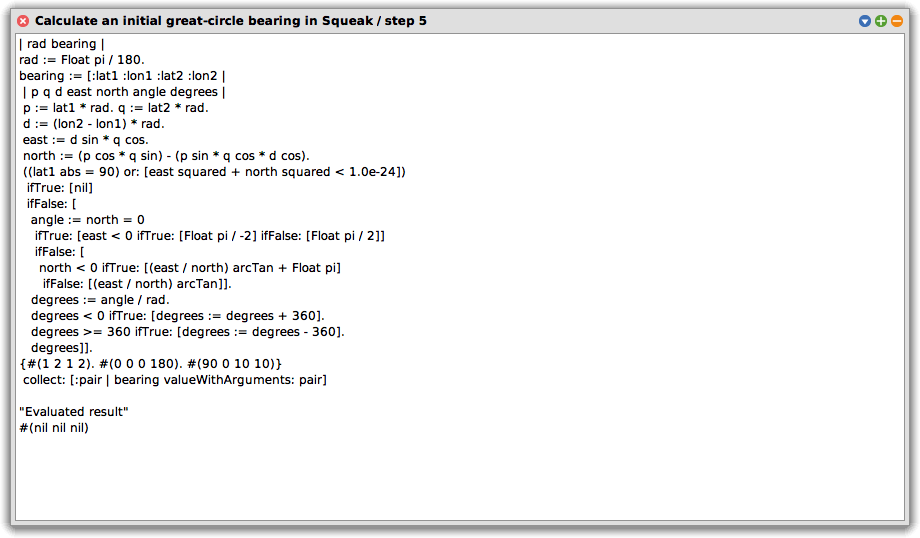
Try it: Swap the first and last points of a normal route. Both are defined unless one start is a pole.
06 - Make the reciprocal case explicit
On the equator the start and return directions are exactly opposite. This is a special case, not a rule for all great circles.
| rad bearing |
rad := Float pi / 180.
bearing := [:lat1 :lon1 :lat2 :lon2 |
 | p q d east north angle degrees |
 p := lat1 * rad. q := lat2 * rad.
 d := (lon2 - lon1) * rad.
 east := d sin * q cos.
 north := (p cos * q sin) - (p sin * q cos * d cos).
 ((lat1 abs = 90) or: [east squared + north squared < 1.0e-24])
  ifTrue: [nil]
  ifFalse: [
   angle := north = 0
    ifTrue: [east < 0 ifTrue: [Float pi / -2] ifFalse: [Float pi / 2]]
    ifFalse: [
     north < 0 ifTrue: [(east / north) arcTan + Float pi]
      ifFalse: [(east / north) arcTan]].
   degrees := angle / rad.
   degrees < 0 ifTrue: [degrees := degrees + 360].
   degrees >= 360 ifTrue: [degrees := degrees - 360].
   degrees]].
{#(0 0 0 10). #(0 10 0 0)}
 collect: [:pair | (bearing valueWithArguments: pair) rounded]
Expected: #(90 270)
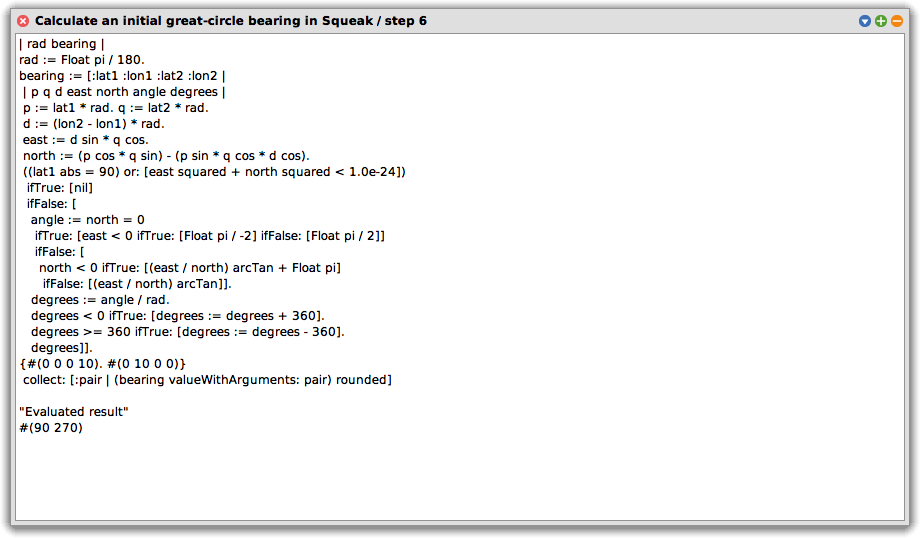
Try it: Compare this pair with the 35° latitude pair.
Replay the checkpoints
Reason about correctness and limits
Assumes valid latitudes in −90° to +90° and ordinary longitude inputs in degrees. This is a spherical teaching model, not a navigational calculator or an ellipsoidal inverse solution.
A departure at a pole has no unambiguous local north in this model. Coincident or antipodal positions, and numerically close approximations to them, return nil.
An initial bearing is not a constant heading along a great circle. Reverse-route initial bearing need not be 180° from the forward one.
Three practice challenges
Recognize a reciprocal
Which example reverses by exactly 180 degrees?
Show solution
The due-east equatorial route reverses to due west. The two 35° latitude headings do not differ by 180°.
Name the two-argument idea
Why not just divide and apply arctangent?
Show solution
Division loses quadrant information and fails when north is zero. Using both components is the idea behind atan2.
Know what the output means
If a route starts at 60°, do you hold that heading to the end?
Show solution
Not generally. This is the local direction at the start of a great-circle route.
Reference
Chris Veness’s spherical bearing derivation and implementation
Continue learning
Haversine Distance | First Point
Environment reference: official Squeak documentation. This lesson and its examples are original. Verified using native Squeak 6.1 build 23976 on Linux.