SMALLTALK LAB
Maximum Subarray in Squeak: Kadane’s Running Decision
Find the best contiguous run in linear time, recover its endpoints, handle all-negative input, and cross-check the result with a brute-force oracle.
Before you begin
Use a fresh Workspace and Print it on each complete independent expression. Arrays must be nonempty and numeric. A subarray is contiguous and must contain at least one element in this lesson. The native visual replay shows a running sum and the best interval so far.
These are native Squeak 6.1 examples. Each checkpoint is independent: open the download as text, copy one complete expression into Workspace and choose Print it. Do not file in the checkpoint collection as a class definition.
Expected values are Smalltalk expressions. The printer may show explicit Symbol markers: #(A B) and #(#A #B) represent the same array of Symbols.
01 - Distinguish a contiguous run from a subsequence
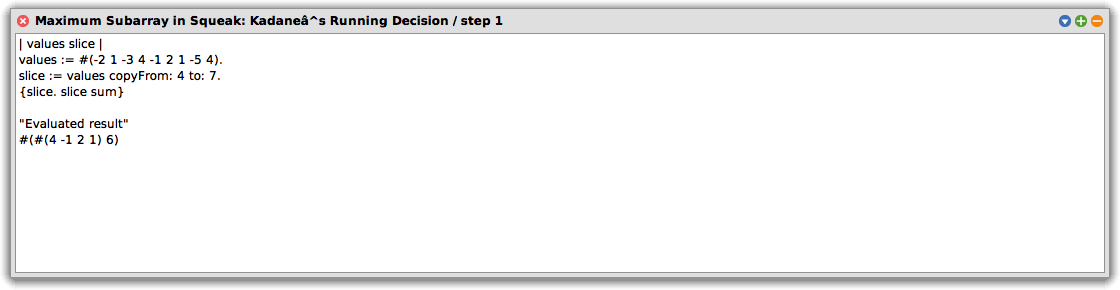
Choose one uninterrupted slice. You cannot skip a loss inside the selected interval. In this example the best slice is #(4 -1 2 1), not the disconnected positive values. copyFrom:to: includes both one-based endpoints.
| values slice |
values := #(-2 1 -3 4 -1 2 1 -5 4).
slice := values copyFrom: 4 to: 7.
{slice. slice sum}
Expected: #(#(4 -1 2 1) 6)
Try it: Compare the slice sum with the sum of all positive elements; that solves a different problem.
02 - Decide whether to extend or restart
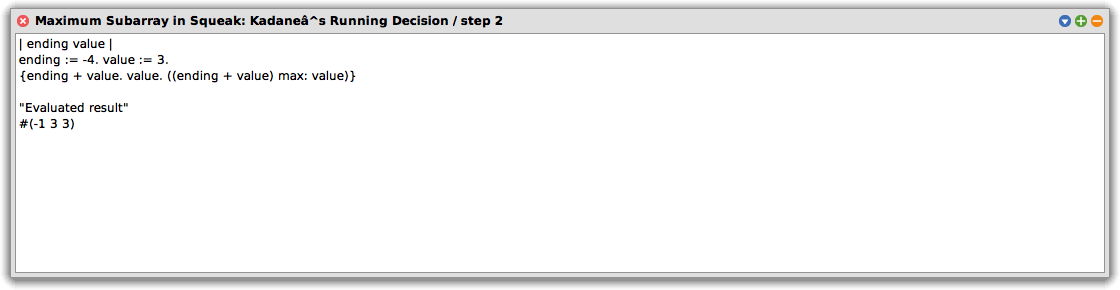
Let ending be the best sum of a nonempty subarray ending at the previous position. For the next value, either extend that subarray or start fresh. If ending is negative, carrying it forward can only hurt. This recurrence is local, but its best-so-far value will give a global answer.
| ending value |
ending := -4. value := 3.
{ending + value. value. ((ending + value) max: value)}
Expected: #(-1 3 3)
Try it: If ending is 5 and the next value is -2, extend to 3 rather than restart at -2.
03 - Track endings separately from the best answer
The best sum ending here may go down. The best sum anywhere so far cannot go down. This checkpoint records both after every input element. Initialization from the first value enforces the nonempty requirement.
| values ending best endings bests |
values := #(-2 1 -3 4 -1 2 1 -5 4).
ending := values first. best := ending.
endings := OrderedCollection with: ending.
bests := OrderedCollection with: best.
2 to: values size do: [:i |
 ending := (values at: i) max: (ending + (values at: i)).
 best := best max: ending.
 endings add: ending. bests add: best].
{endings asArray. bests asArray}
Expected: #(#(-2 1 -2 4 3 5 6 1 5) #(-2 1 1 4 4 5 6 6 6))
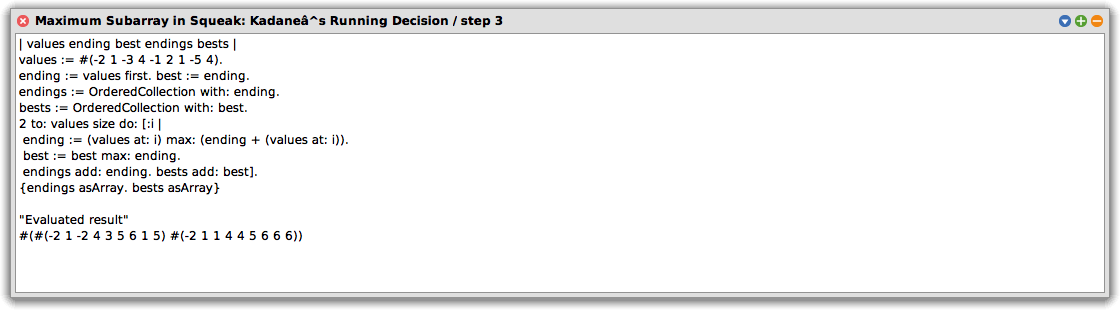
Try it: At position 8 the ending sum falls to 1, but the saved best remains 6.
04 - Save endpoints only when the best improves
start belongs to the currently active candidate. bestStart and bestEnd belong to the saved answer. Update the saved endpoints only on a strict improvement. With this tie policy, zero-sum prefixes are retained and an already saved equal best is not replaced.
| values ending best start bestStart bestEnd |
values := #(-2 1 -3 4 -1 2 1 -5 4).
ending := values first. best := ending.
start := 1. bestStart := 1. bestEnd := 1.
2 to: values size do: [:i | | value |
 value := values at: i.
 ending < 0
  ifTrue: [ending := value. start := i]
  ifFalse: [ending := ending + value].
 ending > best ifTrue: [
  best := ending. bestStart := start. bestEnd := i]].
{best. bestStart. bestEnd. values copyFrom: bestStart to: bestEnd}
Expected: #(6 4 7 #(4 -1 2 1))
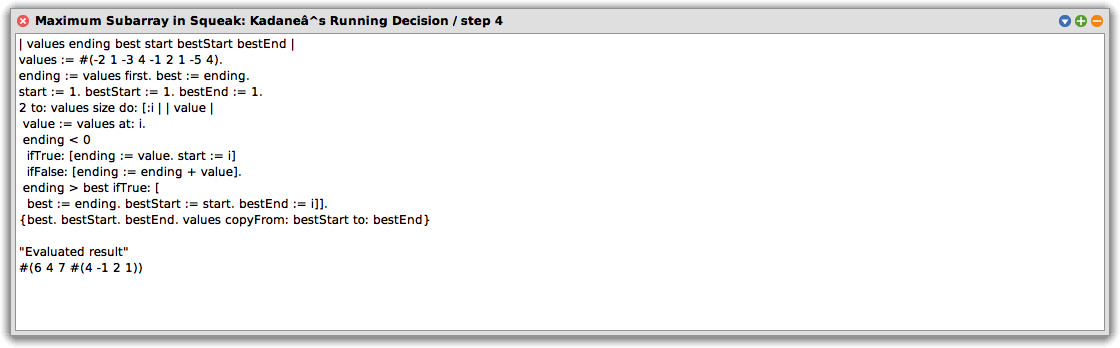
Try it: The interval is inclusive; its length is bestEnd - bestStart + 1.
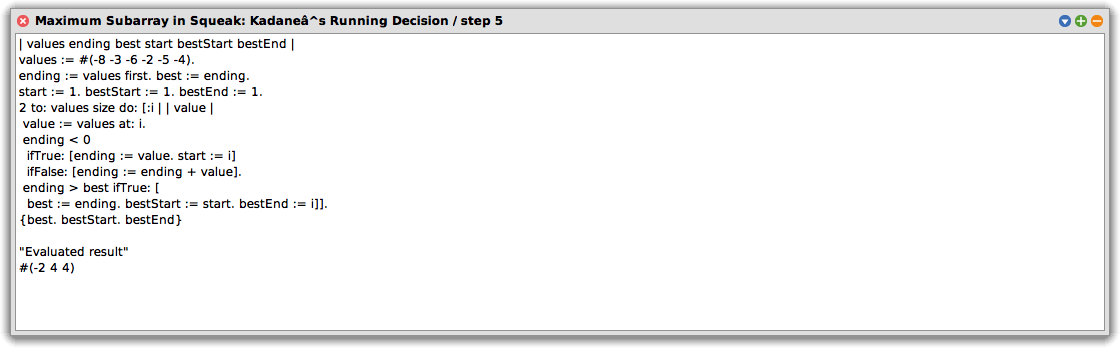
05 - Keep an all-negative answer nonempty
Initializing best to zero would silently allow the empty subarray and produce a wrong answer for this contract. Starting from the first element finds the least-negative value instead. A one-element array follows the same logic with no loop iterations.
| values ending best start bestStart bestEnd |
values := #(-8 -3 -6 -2 -5 -4).
ending := values first. best := ending.
start := 1. bestStart := 1. bestEnd := 1.
2 to: values size do: [:i | | value |
 value := values at: i.
 ending < 0
  ifTrue: [ending := value. start := i]
  ifFalse: [ending := ending + value].
 ending > best ifTrue: [
  best := ending. bestStart := start. bestEnd := i]].
{best. bestStart. bestEnd}
Expected: #(-2 4 4)
Try it: Try #(-7), then #(0). Their answers are -7 and 0, both with endpoints 1 and 1.
06 - Make ties deliberate and predictable
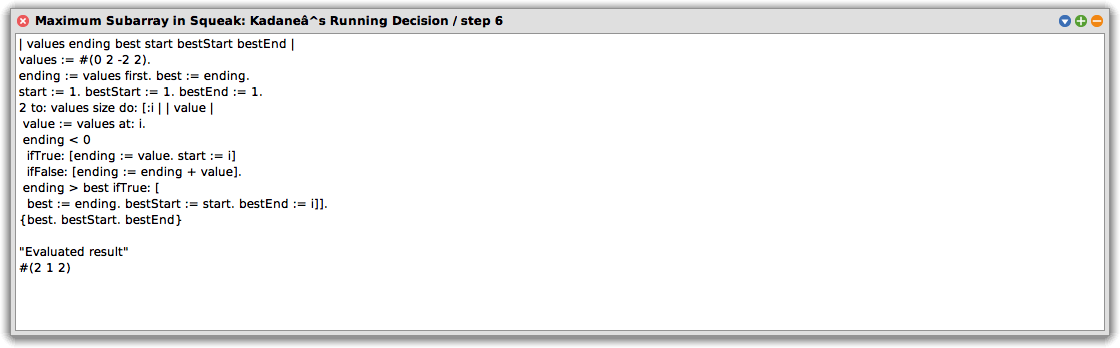
Restart only when ending is strictly negative, and save only when ending is strictly greater than best. This keeps the earliest ending among equal best sums; for that ending it retains the earliest start produced by keeping zero-sum prefixes. Different valid policies can return a different interval with the same maximum sum.
| values ending best start bestStart bestEnd |
values := #(0 2 -2 2).
ending := values first. best := ending.
start := 1. bestStart := 1. bestEnd := 1.
2 to: values size do: [:i | | value |
 value := values at: i.
 ending < 0
  ifTrue: [ending := value. start := i]
  ifFalse: [ending := ending + value].
 ending > best ifTrue: [
  best := ending. bestStart := start. bestEnd := i]].
{best. bestStart. bestEnd}
Expected: #(2 1 2)
Try it: Changing ending < 0 to ending <= 0 drops zero-sum prefixes and favors shorter starts. Changing > to >= changes which equal best ending is retained.
07 - Build a small independent oracle
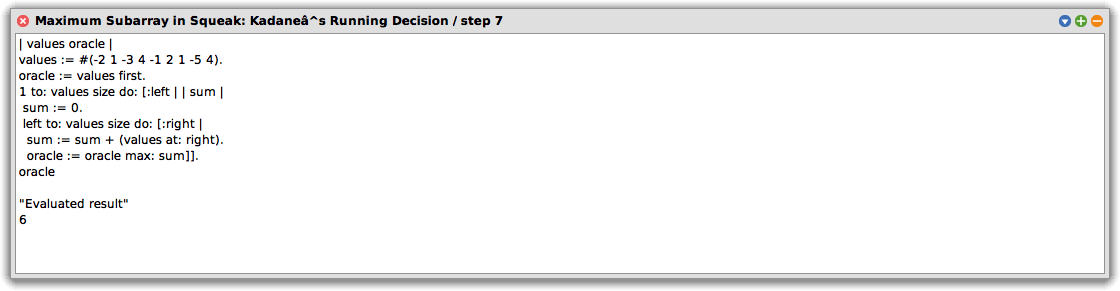
For short inputs, enumerate all contiguous intervals. Extend a running sum for each start rather than recomputing each slice. This O(n squared) oracle follows a different route from Kadane and makes an effective test. Keep it small; it is not the production algorithm.
| values oracle |
values := #(-2 1 -3 4 -1 2 1 -5 4).
oracle := values first.
1 to: values size do: [:left | | sum |
 sum := 0.
 left to: values size do: [:right |
  sum := sum + (values at: right).
  oracle := oracle max: sum]].
oracle
Expected: 6
Try it: The oracle checks the maximum sum. Endpoint tie policies need separate tests.
08 - Cross-check several boundary cases
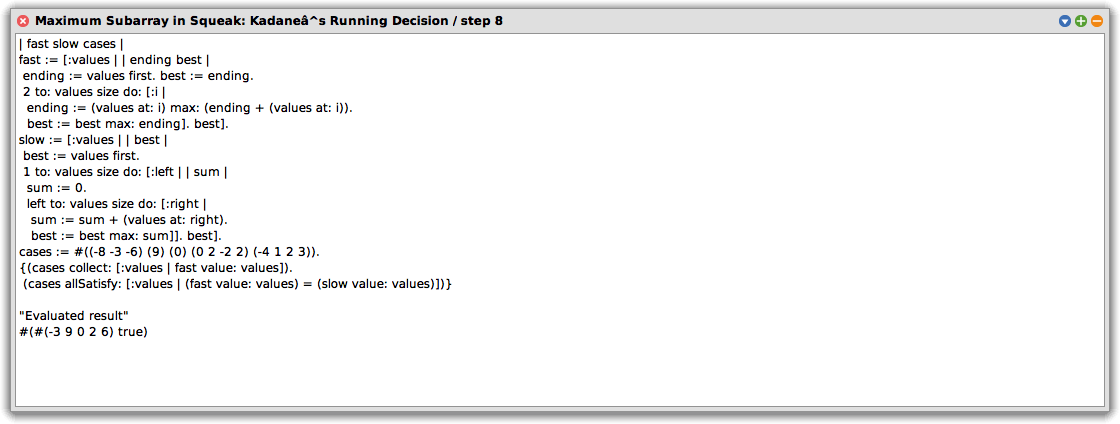
Package each implementation as a block, then compare them on short varied arrays. Test all-negative, singleton, zero, ties, and a maximum at the final element. The linear algorithm uses O(n) arithmetic operations and O(1) auxiliary storage when it does not save trace arrays.
| fast slow cases |
fast := [:values | | ending best |
 ending := values first. best := ending.
 2 to: values size do: [:i |
  ending := (values at: i) max: (ending + (values at: i)).
  best := best max: ending]. best].
slow := [:values | | best |
 best := values first.
 1 to: values size do: [:left | | sum |
  sum := 0.
  left to: values size do: [:right |
   sum := sum + (values at: right).
   best := best max: sum]]. best].
cases := #((-8 -3 -6) (9) (0) (0 2 -2 2) (-4 1 2 3)).
{(cases collect: [:values | fast value: values]).
 (cases allSatisfy: [:values | (fast value: values) = (slow value: values)])}
Expected: #(#(-3 9 0 2 6) true)
Try it: Add #(-1 5 -1 5 -20) and expect 9. Reject empty input before calling either block.
Watch the computed states
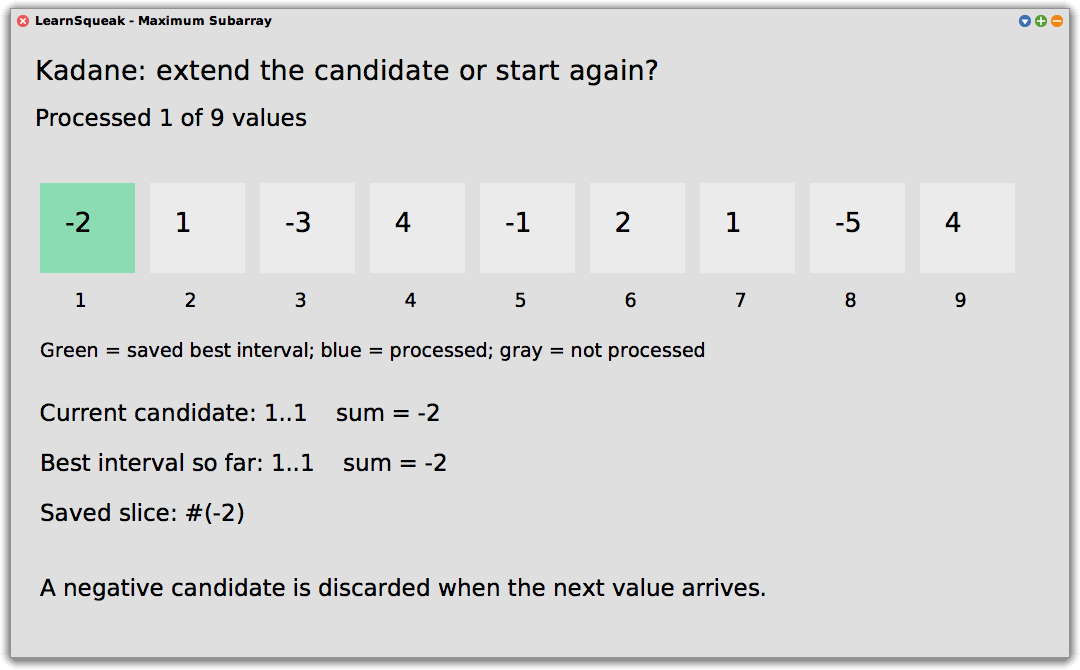
Download the visual experiment. Select the entire expression and Do it. Change stage := 0. to another supported stage, close the previous window, and run again. The GIF replays those native states. This example needs native Squeak; no new browser playground compatibility is claimed.
Reason about correctness and limits
A subarray is contiguous; a subsequence may skip values. Selecting all positive elements is not Kadane’s problem.
The empty array has no nonempty subarray. These expressions require a nonempty array; a reusable method should reject emptiness or return an explicit absence result.
Do not initialize a nonempty maximum to zero. That fails on all-negative data.
The active candidate start is not necessarily the saved answer start. Keep separate endpoint variables.
Ties are not errors: several intervals can have the same maximum sum. Document the restart and replacement rules.
Integer examples are exact. Floating-point inputs introduce rounding, and NaN or infinities need a separately specified contract.
The linear running algorithm needs constant auxiliary space. The trace checkpoint deliberately stores O(n) states for teaching; the verification oracle deliberately takes O(n squared) time.
Three practice challenges
Maximum at the end
Find the sum and endpoints for #(-5 2 -1 4).
Show solution
The maximum is 5 for positions 2 through 4: #(2 -1 4). The final position improves the best answer.
Allow the empty interval
How would the result contract change if an empty subarray were allowed?
Show solution
Its sum is zero, so all-negative inputs would return zero and an explicit empty interval. Initialize running and best sums to zero and clamp the running sum to zero, but define an unambiguous endpoint representation for emptiness.
Minimum subarray
Adapt the recurrence to find a nonempty minimum-sum interval.
Show solution
Replace max: with min:, restart when the previous ending sum is positive, and save a strict smaller best. Initialize from the first element to preserve nonempty semantics.
Continue learning
Sliding Window | Prefix Sums | Collections
Environment reference: official Squeak documentation. This lesson and its examples are original. Verified using native Squeak 6.1 build 23976 on Linux.