SMALLTALK LAB
Median Absolute Deviation in Squeak: Measure Spread Robustly
Compute a robust measure of spread for a short response-time sample. Work through the median, absolute distances, extreme values and the zero-MAD corner case.
Before you begin
Open a Squeak Workspace. Use Print it on the complete checkpoint, including its temporary variable declarations.
These are native Squeak 6.1 examples. Each checkpoint is independent: open the download as text, copy one complete expression into Workspace and choose Print it. Do not file in the checkpoint collection as a class definition.
Expected values are Smalltalk expressions. The printer may show explicit Symbol markers: #(A B) and #(#A #B) represent the same array of Symbols.
01 - Sort before choosing the center
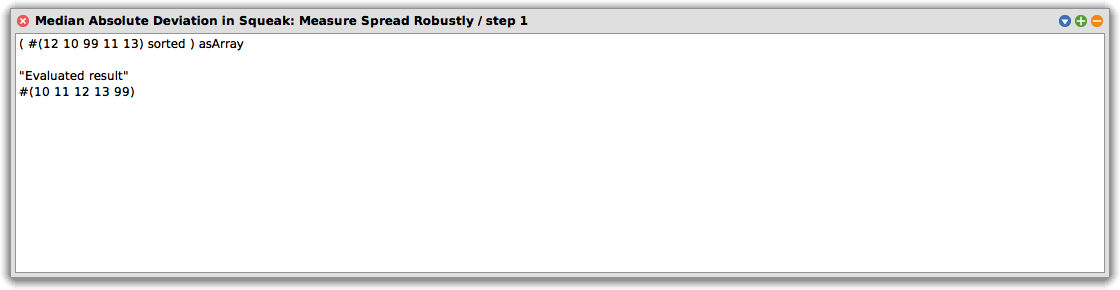
Distances need a reference point. Sorting places the middle of this odd-length list at index three, giving 12 even with an extreme value at the end.
( #(12 10 99 11 13) sorted ) asArrayExpected: #(10 11 12 13 99)
Try it: Replace 99 by 999. The middle value stays the same.
02 - Write a median for both lengths
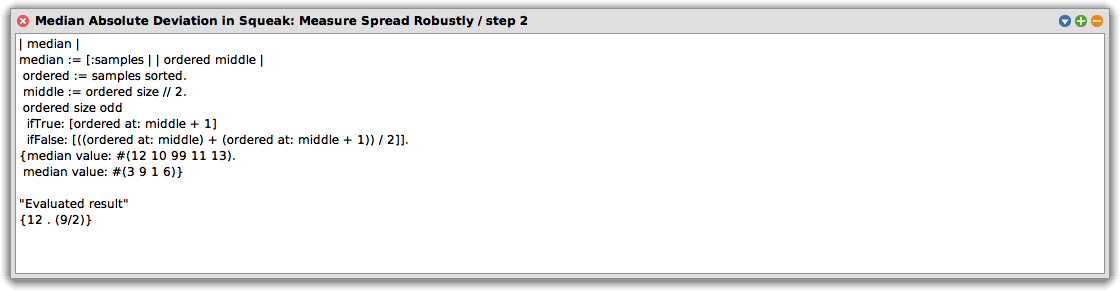
An even list has two middle neighbors. Here they are 3 and 6; averaging with Smalltalk division preserves the exact fraction. The block assumes nonempty input.
| median |
median := [:samples | | ordered middle |
 ordered := samples sorted.
 middle := ordered size // 2.
 ordered size odd
  ifTrue: [ordered at: middle + 1]
  ifFalse: [((ordered at: middle) + (ordered at: middle + 1)) / 2]].
{median value: #(12 10 99 11 13).
 median value: #(3 9 1 6)}
Expected: {12. 9/2}
Try it: Try a single value and check that it returns unchanged.
03 - Measure distances from the center
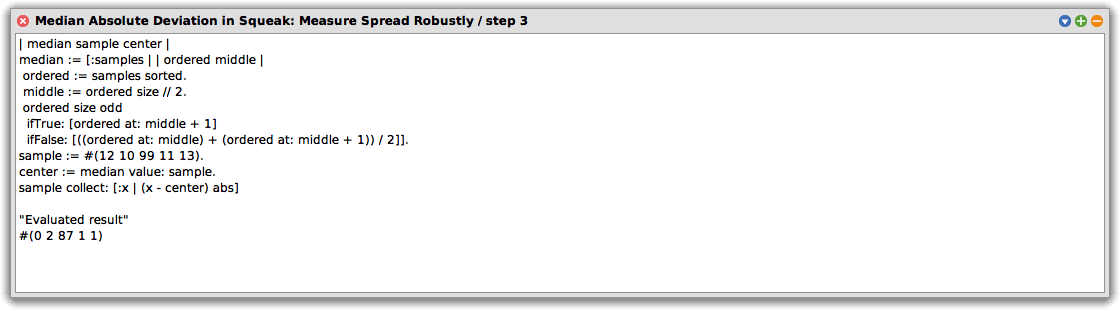
Take absolute distances so values on different sides do not cancel. Keep original order here so the large distance can be associated with 99.
| median sample center |
median := [:samples | | ordered middle |
 ordered := samples sorted.
 middle := ordered size // 2.
 ordered size odd
  ifTrue: [ordered at: middle + 1]
  ifFalse: [((ordered at: middle) + (ordered at: middle + 1)) / 2]].
sample := #(12 10 99 11 13).
center := median value: sample.
sample collect: [:x | (x - center) abs]
Expected: #(0 2 87 1 1)
Try it: The sample value equal to the median contributes distance zero.
04 - Take the second median
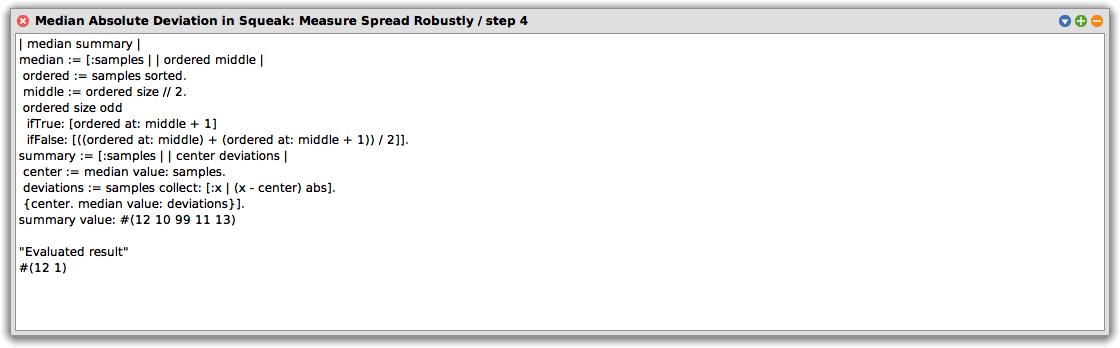
The five distances sort to 0, 1, 1, 2, 87. The median of the distances is 1. This is the raw MAD, in the same units as the sample.
| median summary |
median := [:samples | | ordered middle |
 ordered := samples sorted.
 middle := ordered size // 2.
 ordered size odd
  ifTrue: [ordered at: middle + 1]
  ifFalse: [((ordered at: middle) + (ordered at: middle + 1)) / 2]].
summary := [:samples | | center deviations |
 center := median value: samples.
 deviations := samples collect: [:x | (x - center) abs].
 {center. median value: deviations}].
summary value: #(12 10 99 11 13)
Expected: #(12 1)
Try it: MAD means median absolute deviation here, not mean absolute deviation.
05 - Check resilience to a large outlier
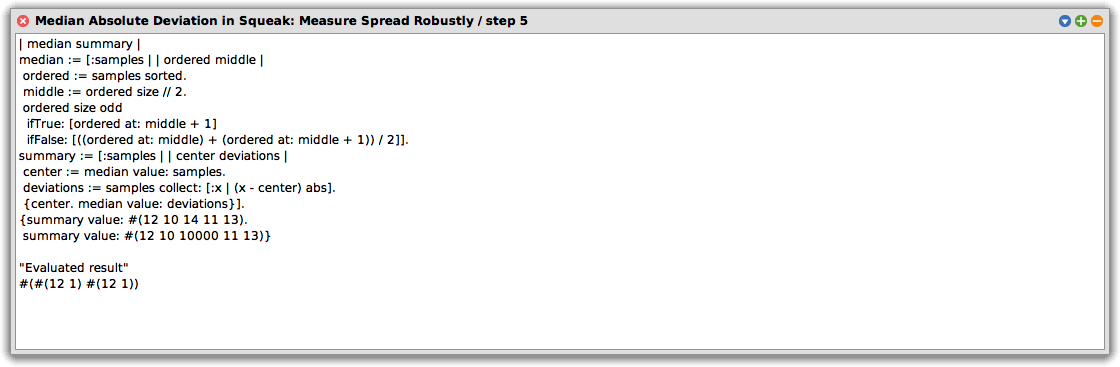
A more extreme final observation raises the biggest distance without changing the median or the middle distance. Robust does not mean unchanged under every possible edit; adding many extreme observations can shift the medians.
| median summary |
median := [:samples | | ordered middle |
 ordered := samples sorted.
 middle := ordered size // 2.
 ordered size odd
  ifTrue: [ordered at: middle + 1]
  ifFalse: [((ordered at: middle) + (ordered at: middle + 1)) / 2]].
summary := [:samples | | center deviations |
 center := median value: samples.
 deviations := samples collect: [:x | (x - center) abs].
 {center. median value: deviations}].
{summary value: #(12 10 14 11 13).
 summary value: #(12 10 10000 11 13)}
Expected: #((12 1) (12 1))
Try it: Replace three observations instead of one. Predict when the middle position moves.
06 - Give a zero result a safe interpretation
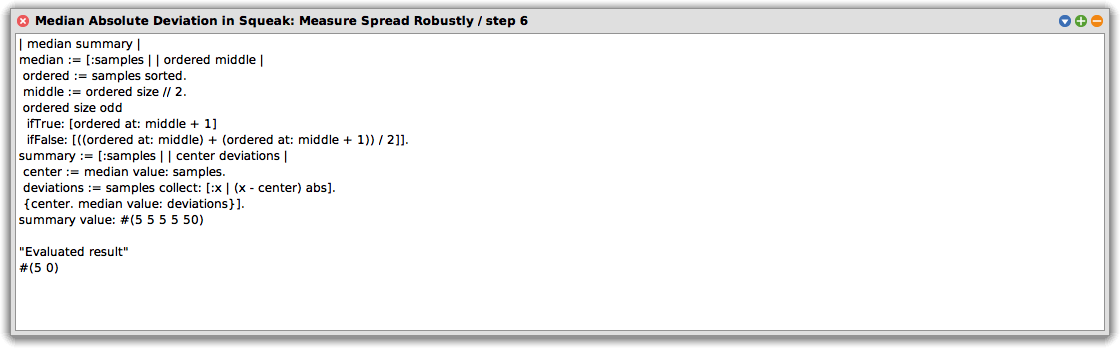
A majority at one value can make the MAD zero despite a distant observation. Report the result instead of dividing by zero. Raw MAD is not a standard deviation; under a normal-model assumption a common consistency factor is approximately 1.4826.
| median summary |
median := [:samples | | ordered middle |
 ordered := samples sorted.
 middle := ordered size // 2.
 ordered size odd
  ifTrue: [ordered at: middle + 1]
  ifFalse: [((ordered at: middle) + (ordered at: middle + 1)) / 2]].
summary := [:samples | | center deviations |
 center := median value: samples.
 deviations := samples collect: [:x | (x - center) abs].
 {center. median value: deviations}].
summary value: #(5 5 5 5 50)
Expected: #(5 0)
Try it: Look at the count of exact ties and the raw observations before interpreting a zero.
Replay the checkpoints
Reason about correctness and limits
The 1.4826 scaling is a large-sample normal consistency convention, not a correction that makes MAD identical to standard deviation for arbitrary samples.
This teaching implementation sorts twice, making it O(n log n). Choose explicit input validation and an empty-input policy for reusable code.
Three practice challenges
Constant shift
What changes if every value increases by ten?
Show solution
The center increases by ten; the MAD is unchanged.
Change units
What happens when all milliseconds are converted to microseconds?
Show solution
Both the center and MAD multiply by 1,000.
Find the even-case distance
What is the MAD for 1, 2, 4, 5?
Show solution
Median 3; distances 2, 1, 1, 2, so the median distance is 3/2.
Continue learning
Online Variance | Probability Lab | First Absolute
Environment reference: official Squeak documentation. This lesson and its examples are original. Verified using native Squeak 6.1 build 23976 on Linux.