SMALLTALK LAB
Simplify a path with Douglas–Peucker
Keep the meaningful bends of an open polyline with a distance tolerance.
Before you begin
Open a Workspace in native Squeak and use Print it on one complete checkpoint at a time.
These are native Squeak 6.1 examples. Each checkpoint is independent: open the download as text, copy one complete expression into Workspace and choose Print it. Do not file in the checkpoint collection as a class definition.
Expected values are Smalltalk expressions. The printer may display equivalent Smalltalk literals with different spaces or delimiters.
01 - Measure to the nearest point on a segment
Compute the projection fraction using a dot product. Clamp it to 0–1 so a point past an end is compared to that endpoint, not to the infinite line. A segment with equal endpoints reduces to a point.
| dist2 |
dist2 := [:p :a :b |
 | dx dy px py len t rx ry |
 dx := b x - a x. dy := b y - a y.
 px := p x - a x. py := p y - a y.
 len := dx squared + dy squared.
 t := len = 0 ifTrue: [0] ifFalse: [
  ((((px * dx) + (py * dy)) / len) max: 0) min: 1].
 rx := px - (t * dx). ry := py - (t * dy).
 rx squared + ry squared].
{dist2 value: 3@1 value: 0@0 value: 2@0.
 dist2 value: 3@4 value: 0@0 value: 0@0}
Expected: #(2 25)
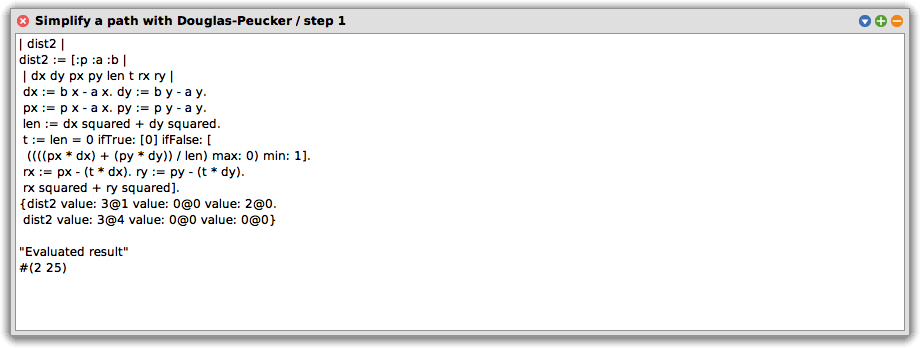
Try it: The first squared distance is 2 because the nearest point is 2@0.
02 - Find the bend that breaks the chord
The chord from the first point to the last lies along y = 0. The apex has squared distance 4, so it is 2 units away.
| dist2 path |
dist2 := [:p :a :b |
 | dx dy px py len t rx ry |
 dx := b x - a x. dy := b y - a y.
 px := p x - a x. py := p y - a y.
 len := dx squared + dy squared.
 t := len = 0 ifTrue: [0] ifFalse: [
  ((((px * dx) + (py * dy)) / len) max: 0) min: 1].
 rx := px - (t * dx). ry := py - (t * dy).
 rx squared + ry squared].
path := {0@0. 1@0. 2@2. 3@0. 4@0}.
(2 to: 4) collect: [:i |
 dist2 value: (path at: i) value: path first value: path last]
Expected: #(0 4 0)
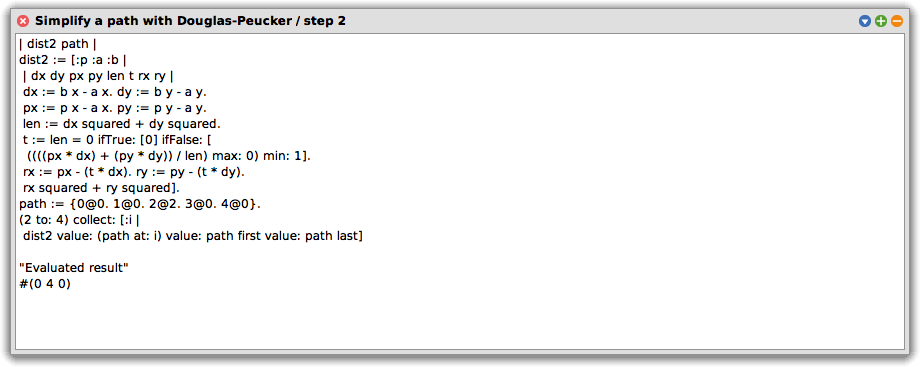
Try it: Raise the apex by one. Its squared distance becomes 9.
03 - Split at the farthest point
With a tolerance of 1, keep the apex and repeat the test on each side. Both remaining intermediate points are less than one unit from their shorter chords.
| dist2 reduce |
dist2 := [:p :a :b |
 | dx dy px py len t rx ry |
 dx := b x - a x. dy := b y - a y.
 px := p x - a x. py := p y - a y.
 len := dx squared + dy squared.
 t := len = 0 ifTrue: [0] ifFalse: [
  ((((px * dx) + (py * dy)) / len) max: 0) min: 1].
 rx := px - (t * dx). ry := py - (t * dy).
 rx squared + ry squared].
reduce := [:points :epsilon |
 | keep visit |
 epsilon < 0 ifTrue: [Error signal: 'Use a nonnegative tolerance'].
 keep := OrderedCollection new.
 visit := [:lo :hi |
  | a b worst split d |
  a := points at: lo. b := points at: hi.
  worst := epsilon squared. split := nil.
  lo + 1 to: hi - 1 do: [:i |
   d := dist2 value: (points at: i) value: a value: b.
   d > worst ifTrue: [worst := d. split := i]].
  split ifNil: [keep add: b] ifNotNil: [
   visit value: lo value: split.
   visit value: split value: hi]].
 points isEmpty ifFalse: [
  keep add: points first.
  points size > 1 ifTrue: [visit value: 1 value: points size]].
 keep asArray].
reduce value: {0@0. 1@0. 2@2. 3@0. 4@0} value: 1
Expected: {0@0. 2@2. 4@0}
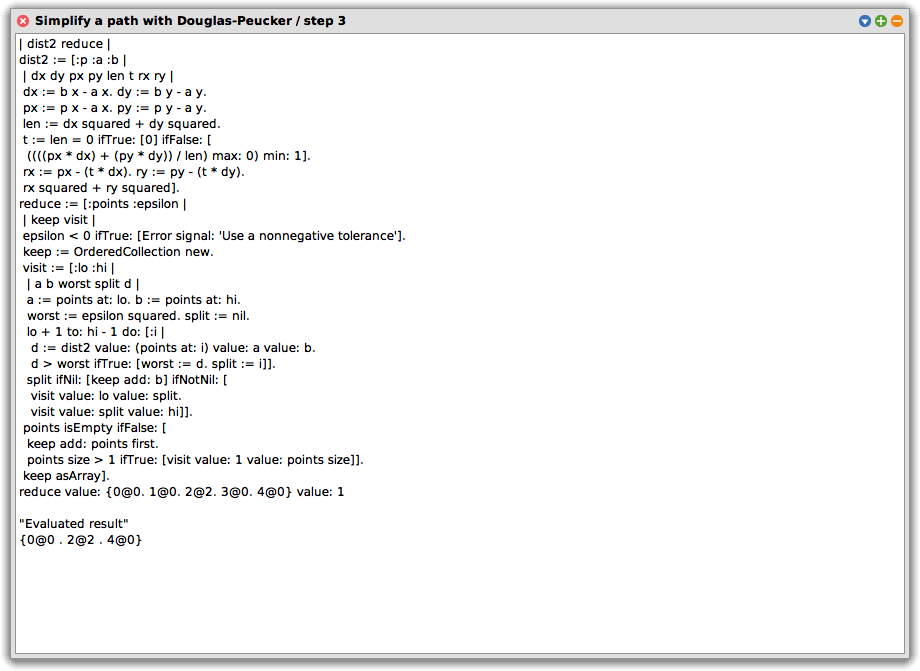
Try it: Notice how the shared apex appears just once; the left branch emits it and the right branch emits its own end.
04 - Compare three tolerances
At half a unit all the vertices survive. At two units even the apex is within tolerance. A strict greater-than test treats equality as acceptable.
| dist2 reduce path |
dist2 := [:p :a :b |
 | dx dy px py len t rx ry |
 dx := b x - a x. dy := b y - a y.
 px := p x - a x. py := p y - a y.
 len := dx squared + dy squared.
 t := len = 0 ifTrue: [0] ifFalse: [
  ((((px * dx) + (py * dy)) / len) max: 0) min: 1].
 rx := px - (t * dx). ry := py - (t * dy).
 rx squared + ry squared].
reduce := [:points :epsilon |
 | keep visit |
 epsilon < 0 ifTrue: [Error signal: 'Use a nonnegative tolerance'].
 keep := OrderedCollection new.
 visit := [:lo :hi |
  | a b worst split d |
  a := points at: lo. b := points at: hi.
  worst := epsilon squared. split := nil.
  lo + 1 to: hi - 1 do: [:i |
   d := dist2 value: (points at: i) value: a value: b.
   d > worst ifTrue: [worst := d. split := i]].
  split ifNil: [keep add: b] ifNotNil: [
   visit value: lo value: split.
   visit value: split value: hi]].
 points isEmpty ifFalse: [
  keep add: points first.
  points size > 1 ifTrue: [visit value: 1 value: points size]].
 keep asArray].
path := {0@0. 1@0. 2@2. 3@0. 4@0}.
#(0.5 1 2) collect: [:eps | (reduce value: path value: eps) size]
Expected: #(5 3 2)
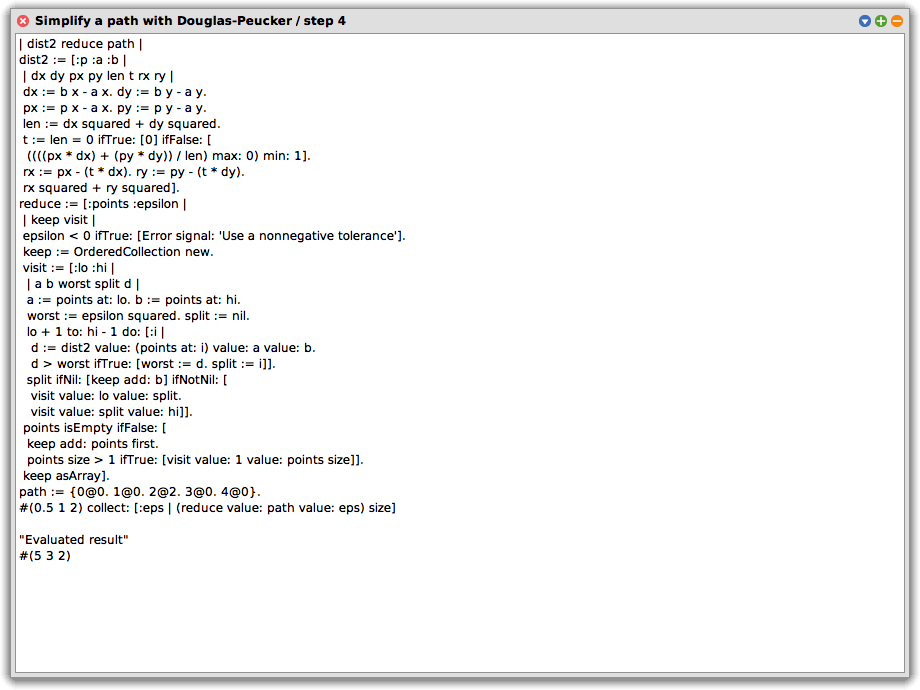
Try it: Predict the count at a tolerance of zero for this particular zigzag.
05 - Handle very short input
Avoid reading nonexistent endpoints for an empty path. Return the one supplied point for a singleton, and reject a negative tolerance.
| dist2 reduce |
dist2 := [:p :a :b |
 | dx dy px py len t rx ry |
 dx := b x - a x. dy := b y - a y.
 px := p x - a x. py := p y - a y.
 len := dx squared + dy squared.
 t := len = 0 ifTrue: [0] ifFalse: [
  ((((px * dx) + (py * dy)) / len) max: 0) min: 1].
 rx := px - (t * dx). ry := py - (t * dy).
 rx squared + ry squared].
reduce := [:points :epsilon |
 | keep visit |
 epsilon < 0 ifTrue: [Error signal: 'Use a nonnegative tolerance'].
 keep := OrderedCollection new.
 visit := [:lo :hi |
  | a b worst split d |
  a := points at: lo. b := points at: hi.
  worst := epsilon squared. split := nil.
  lo + 1 to: hi - 1 do: [:i |
   d := dist2 value: (points at: i) value: a value: b.
   d > worst ifTrue: [worst := d. split := i]].
  split ifNil: [keep add: b] ifNotNil: [
   visit value: lo value: split.
   visit value: split value: hi]].
 points isEmpty ifFalse: [
  keep add: points first.
  points size > 1 ifTrue: [visit value: 1 value: points size]].
 keep asArray].
{reduce value: #() value: 1.
 reduce value: {3@4} value: 1.
 [reduce value: {3@4} value: -1] on: Error do: [:ex | #rejected]}
Expected: {#(). {3@4}. #rejected}
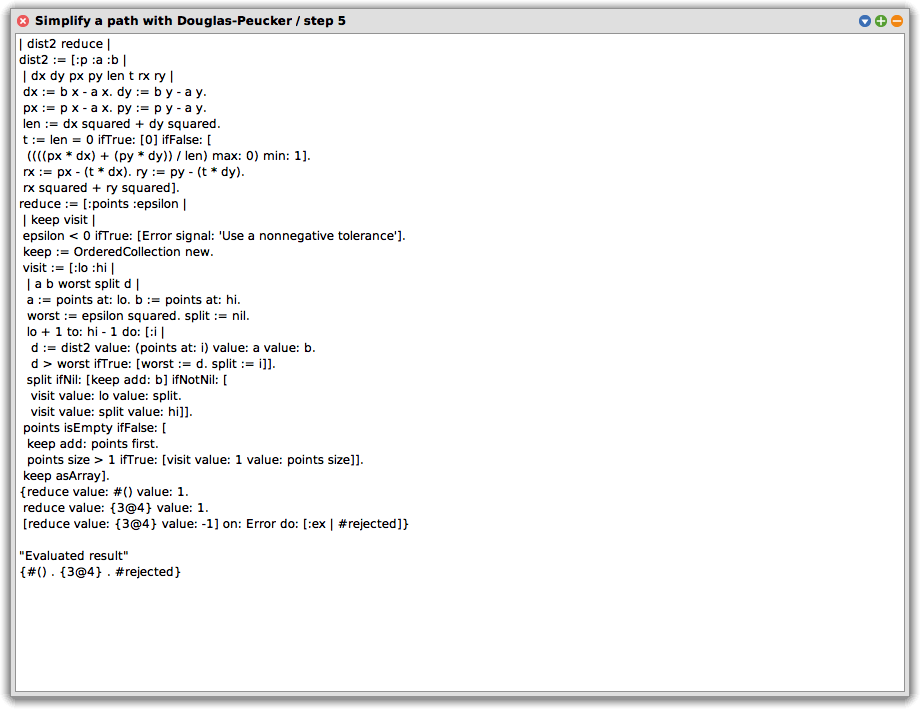
Try it: Pass two points. Both endpoints remain.
06 - Remove collinear waypoints at zero tolerance
Points on a straight chord have exactly zero deviation. Zero tolerance forbids changing the line, not removing waypoints that lie on it.
| dist2 reduce |
dist2 := [:p :a :b |
 | dx dy px py len t rx ry |
 dx := b x - a x. dy := b y - a y.
 px := p x - a x. py := p y - a y.
 len := dx squared + dy squared.
 t := len = 0 ifTrue: [0] ifFalse: [
  ((((px * dx) + (py * dy)) / len) max: 0) min: 1].
 rx := px - (t * dx). ry := py - (t * dy).
 rx squared + ry squared].
reduce := [:points :epsilon |
 | keep visit |
 epsilon < 0 ifTrue: [Error signal: 'Use a nonnegative tolerance'].
 keep := OrderedCollection new.
 visit := [:lo :hi |
  | a b worst split d |
  a := points at: lo. b := points at: hi.
  worst := epsilon squared. split := nil.
  lo + 1 to: hi - 1 do: [:i |
   d := dist2 value: (points at: i) value: a value: b.
   d > worst ifTrue: [worst := d. split := i]].
  split ifNil: [keep add: b] ifNotNil: [
   visit value: lo value: split.
   visit value: split value: hi]].
 points isEmpty ifFalse: [
  keep add: points first.
  points size > 1 ifTrue: [visit value: 1 value: points size]].
 keep asArray].
reduce value: {0@0. 1@1. 2@2. 3@3} value: 0
Expected: {0@0. 3@3}
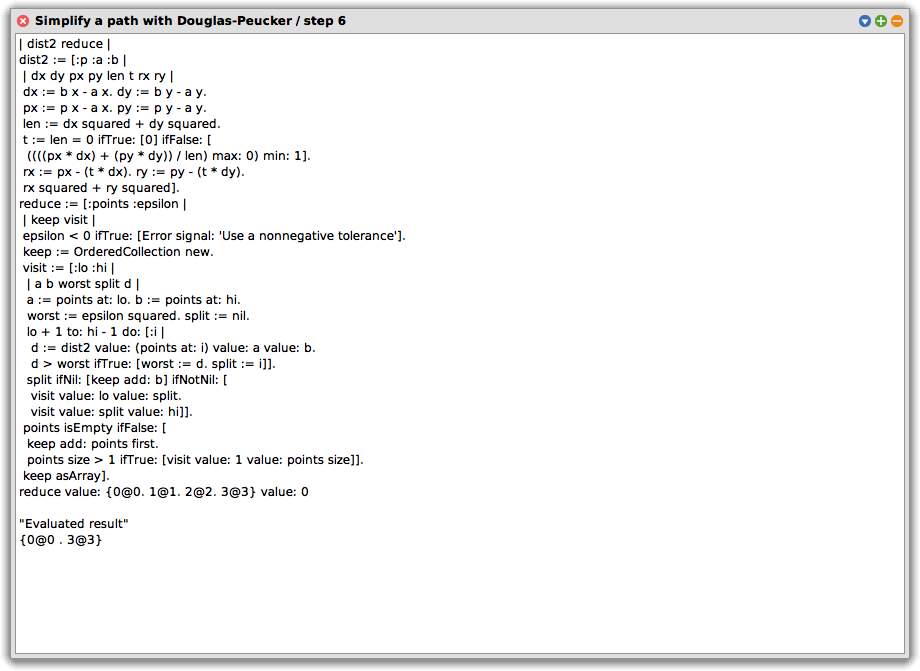
Try it: Move the middle point off the diagonal, then run the same threshold.
Replay the checkpoints
Reason about correctness and limits
Use planar coordinates and nonnegative tolerance in the same units. Project geographic data first for a suitable local scale.
This open-path simplifier does not preserve polygon topology, prevent new intersections, or promise the fewest possible vertices.
Each split scans its interior again. Unbalanced splits can take quadratic time and linear recursion depth.
Three practice challenges
Zero tolerance
Does zero always keep every vertex?
Show solution
No. A vertex lying exactly on the segment can be dropped because its deviation is zero.
Exact tie
What if every interior point lies exactly at the tolerance?
Show solution
Keep only the endpoints of that segment; none exceeds the tolerance.
Change units
If every coordinate doubles, how do you preserve selection?
Show solution
Double the tolerance. Geometric distances also double, or multiply by four in squared form.
Reference
Continue learning
Point In Polygon | First Point
Environment reference: official Squeak documentation. This lesson and its examples are original. Verified using native Squeak 6.1 build 23976 on Linux.