Beyond a tiny interpreter: closures and parser tools
Once a tiny language can run an expression, two questions become interesting: how should its syntax grow, and what should a function remember? This evergreen reading path explores both, connecting our Squeak language-building projects to wider Smalltalk resources.
Published · Curated links & context
WHAT CAUGHT OUR EYE
News & articles
Dates below belong to the original sources. Evergreen resources are labeled separately from dated news.
EVERGREEN INTERPRETER BOOKLET
Physche: follow an interpreter into closures
Stéphane Ducasse's booklet, with Guillermo Polito, builds an educational Scheme subset in Pharo. It moves from a small parser and evaluator to environments, function definitions and lexical closures. The full HTML version lets you follow the explanation beside its code and tests.
Why explore it?
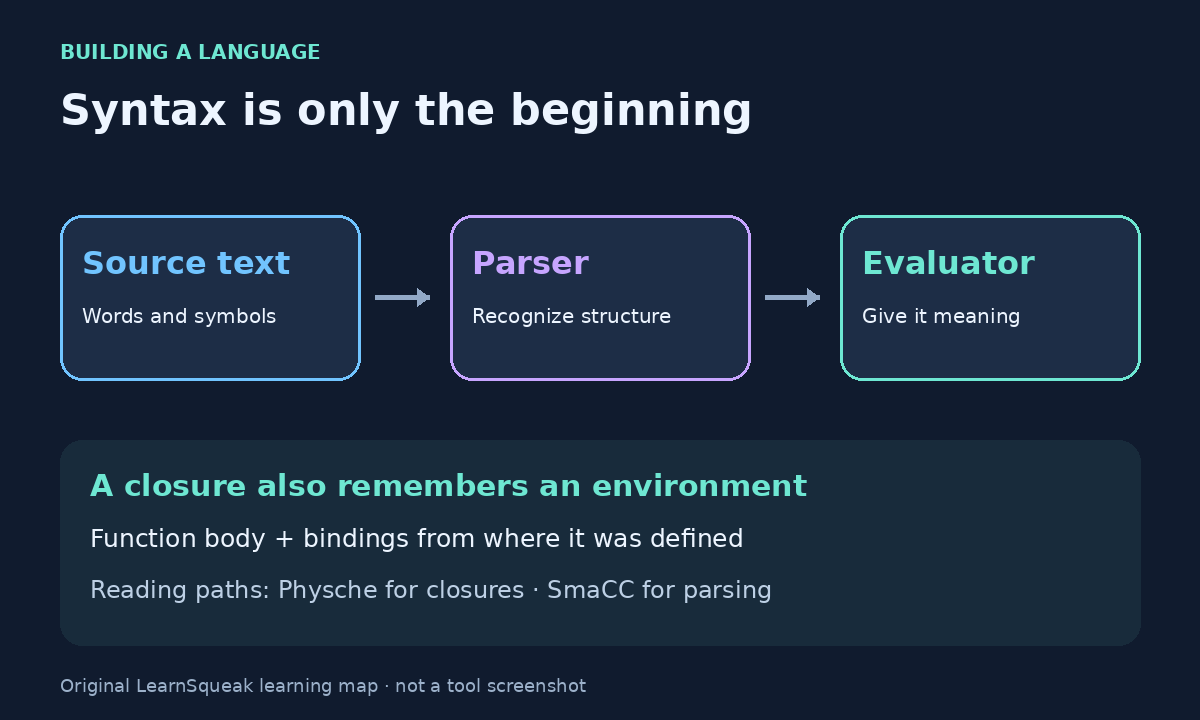
After building a simple evaluator, ask what happens when a function uses a name defined outside its body. Trace where that name is looked up. A closure retains access to the environment in which it was defined; this is a useful next concept beyond evaluating isolated expressions.
Evergreen booklet · Publication date not established
Explore a compiler-compiler framework as another route to recognizing language syntax. Read its tutorial alongside a hand-written parser and compare what each part does: recognizing a structure is different from deciding what that structure means. The repository links its book build; this is not a new-release announcement.
John Brant's SmaCC repository provides the parser-generator source. Use it to investigate the machinery behind the booklet, and check the repository's environment guidance before trying it. A current branch is not a guarantee that code will load unchanged into a particular Pharo or Squeak image.
Related LearnSqueak tutorial · Published 1 November 2026
Our Pebble tutorial implements a small message-oriented language inside Squeak. Use its parser and evaluator as a concrete comparison while reading these external resources. It is a separate teaching language, not an implementation of Physche or SmaCC.
Related LearnSqueak tutorial · Published 1 November 2026
Our native Squeak workshop adds an editor, event code and a visual forms designer to an educational BASIC-like language. Compare the language engine with the interface around it. It is not Visual Basic compatibility, nor a SmaCC-based implementation.
Published 2 November 2026. Physche and the SmaCC resources are newly featured here as evergreen learning material, not fresh news. Physche's online introduction is dated 7 June 2018; the SmaCC booklet's exact publication date was not established. The official Pharo news index still led with the already-covered Pharo 14 announcement when checked. Source pages and links were verified, but external examples were not executed and no current Pharo or Squeak compatibility is claimed. The two local tutorials are related reading, not new releases in this edition. The illustration is original; no third-party artwork, book text or videos are rehosted.